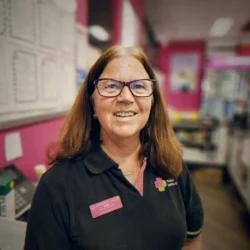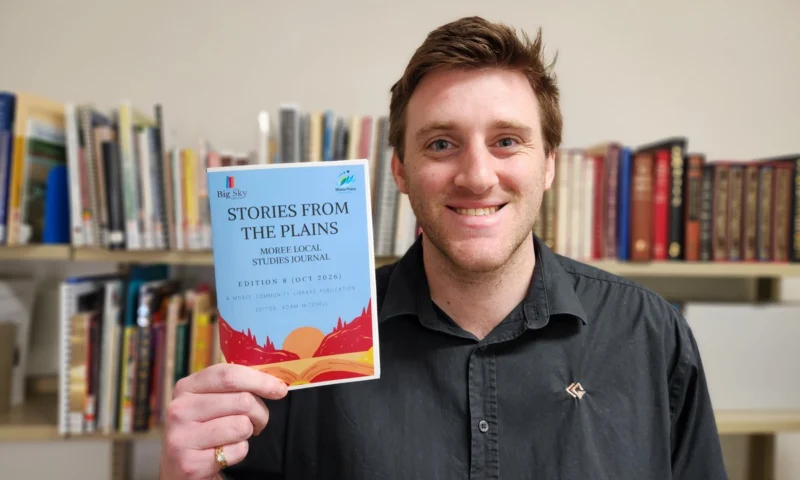
Adam Mitchell, Local Studies and Digitisation Officer at Moree Community Library, with Edition 8 of Stories from the Plains. Photo: Moree Online News
Adam Mitchell has a room full of Moree’s history to look after, but keeping old records safe is only part of his job.
At Moree Community Library, photographs, newspapers, maps and family records hold pieces of the district’s past. Some are carefully catalogued, while others are still being sorted, digitised and made easier to find.
Since becoming the library’s Local Studies and Digitisation Officer in January 2024, Mr Mitchell has been working to make that collection more accessible. He also wanted to give people a reason to explore it. His answer was Stories from the Plains, a local history journal featuring research, photographs and interviews with people whose experiences might otherwise go unrecorded.
The eighth edition, released on November 5, completes the journal’s second year.
The idea grew from a problem Mr Mitchell noticed: many people did not know how much historical material the library held. He wanted to create something they could read and enjoy.
“Plus, I just like writing. It’s what my background is,” he said.
He took the idea to the library and proposed a publication. The first edition appeared in January 2025 under the name Stories of Our Town, with copies printed at the library. Since then, the journal has moved to professional printing, with free digital editions available online.
The project has drawn interest beyond Moree. Mr Mitchell reports invitations to speak about it at state and national library conferences, along with inquiries from other Australian libraries.
Looking after the past
The journal is only one part of Mr Mitchell’s work. He looks after the library’s historical collection, preserving physical records, organising and cataloguing material, making digital copies and helping people access them.
When he arrived, he recalled, much of the collection was stored together in a room. He is still working to organise it as an archive.
Boxes of records are identified by numbers linked to a spreadsheet, although Mr Mitchell wants clearer labels that show what each box contains. He would also like a flat storage cabinet for old maps, which are currently rolled up, but finding space is a challenge.
The collection includes local newspapers, property records, electoral rolls, cemetery and baptism records, photographs, negatives, slides and personal collections. Some material has been digitised, while other records still need attention.
Mr Mitchell described working with organisations including the Moree & District Historical Society and Dhiiyaan Aboriginal Centre to share resources and improve access to local history.
Finding stories less often told
When choosing people to interview, Mr Mitchell generally looks beyond the district’s best-known names.
“I like finding stories that aren’t known,” he said.
He explained that some people’s experiences may never be recorded unless someone takes the time to ask. That interest helped shape the latest edition.
While researching occasions when Moree attracted attention beyond the district, Mr Mitchell came across reports of the Balmain Tigers visiting in 1930. Despite rugby league’s popularity in Moree, he found little about the visit in local historical accounts and began searching newspaper reports through Trove.
Around the same time, he interviewed Bernie Jones, a former cabinetmaker and builder. As Mr Mitchell learned through the interview, Mr Jones recalled working on many of Moree’s buildings. Old photographs prompted memories of businesses, neighbouring shops and changes to the town.
Mr Mitchell had not known that Mr Jones also played rugby league for the Moree Magpies. During the interview, he learned that Mr Jones had played against Balmain during a later visit to Moree.
The unexpected connection helped bring the edition’s football material together.
“It wasn’t really deliberate,” Mr Mitchell said of the sporting theme.
Following the records
Researching Balmain’s 1930 visit meant looking beyond the library’s own collection. Newspaper reports provided much of the information, but photographs were harder to find.
Mr Mitchell located one image described as a Balmain country visit during the 1930s. He included it in the journal with a qualification because he could not confirm whether it was taken in Moree.
“But we’ve got no photos that are definitely of it, which is a shame,” he said.
An earlier visit by a Sydney reserve-grade representative team in 1926 was better documented. Mr Mitchell said he visited the State Library of New South Wales to photograph original prints from the Harold Matthews Collection. Images from that collection appear in the new journal.
The research shows how local history often depends on records held in different places. Newspaper reports, photographs and personal memories can each provide information that the others do not.
Helping families find their history
Much of the library’s local history work begins with people looking for information about their families. Mr Mitchell estimated that one or two people a week visit with research questions, often wanting to know where a relative lived, attended school or was buried.
Some, he explained, travel to Moree because earlier generations of their families lived in the district.
“Most people who come in for local history inquiries are more comfortable if I do the research, which I’m more than happy to do,” he said.
Sometimes he searches the records himself. At other times, he brings out the relevant material for visitors to examine.
The library holds thousands of photographs in different forms. Mr Mitchell explained that copyright restrictions can limit which images staff are able to share. The collection also has gaps. A school photograph from one year may be available while another is missing, and he hopes donations and newly discovered records will help fill those gaps.
More stories to come
Edition 8 of Stories from the Plains runs to 60 pages, featuring Mr Jones’s recollections, historical football photographs and research into visiting rugby league teams. It also includes an advisory about historical language and images of deceased Aboriginal and Torres Strait Islander people.
Free copies of Edition 8 are available at Moree Community Library, with further copies due at the Mungindi Rural Transaction Centre for the journal’s launch there on November 11. Readers can also download Edition 8 free from Council’s website or request a PDF from the library’s Local Studies and Digitisation Officer.
Mr Mitchell has ideas and draft material for future editions, although the subjects are not yet settled. He hopes to include more villages across the Moree Plains whose histories have received less attention.
Meanwhile, the work continues in the library’s archive, where there are still records to organise, photographs to digitise and stories to uncover.