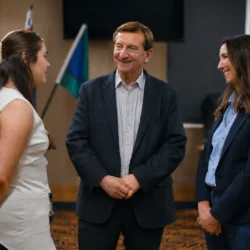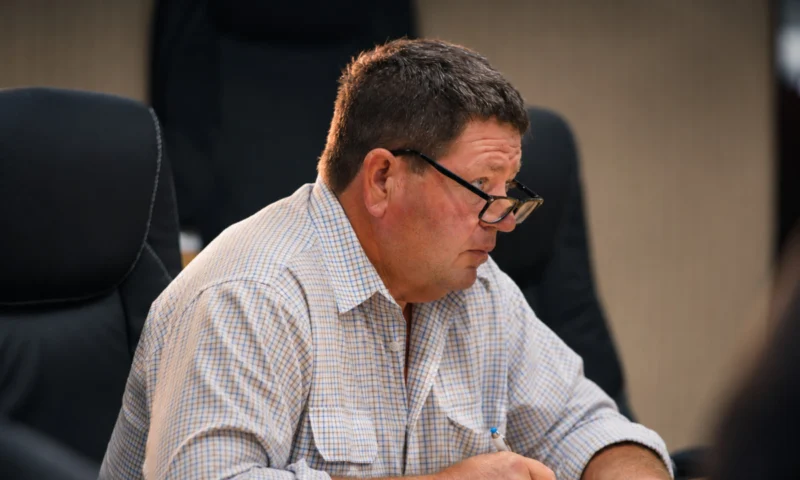
Cr Peter Mailler prior to Tuesday’s meeting between Moree Plains Shire councillors and NSW Local Government Minister Ron Hoenig. Photo: Moree Online News
Moree Plains Shire councillor Peter Mailler has resigned with immediate effect, following Tuesday’s meeting between councillors and NSW Local Government Minister Ron Hoenig.
Mr Mailler had been considering his future on council for some time but had hoped the Minister’s visit would restore his confidence in the system responsible for addressing councillor conduct.
His decision was also influenced by personal circumstances, including the demands of the role and a six-hour round trip to attend council meetings since moving outside the shire.
“This is a sad and deep loss for council and our shire,” Mayor Susannah Pearse said.
Losing confidence in the system
Mr Mailler said he had written to the Minister more than 18 months ago, warning that problems within council could escalate without intervention.
His concerns centred on the handling of complaints referred to the Office of Local Government (OLG) and whether councillors could have confidence in the process going forward.
“I think if the Minister had come with a plausible explanation for what he’s doing and a genuine commitment to do better, I probably wouldn’t have resigned,” he said.
Speaking to Moree Online News following Tuesday’s meeting, Mr Hoenig expressed confidence in councillors and their willingness to undertake training, emphasising the importance of more formal meeting procedures.
Mr Mailler questioned whether further training would address the underlying problems.
“You can’t heal the wounds by smearing concrete over them. It doesn’t work,” he said.
Continued support for the Mayor
Despite his concerns about council’s ability to function effectively, Mr Mailler was particularly concerned that his resignation might be interpreted as a loss of confidence in Ms Pearse.
“I know that me going makes her job harder,” he said.
“I sort of felt obliged to try and support her.”
Mr Mailler credited the working relationship between the Mayor and council’s executive leadership team with providing stability within the organisation, despite the difficulties experienced in the chamber.
Changing attitudes towards rural communities
When Mr Mailler stood for election in 2024, he wanted to ensure the interests of rural ratepayers were adequately represented in decisions affecting the entire shire.
As chair of the Road Network Advisory Committee, he worked to change attitudes towards council’s responsibilities for maintaining its unsealed roads.
For Mr Mailler, the condition of those roads was never simply a farming issue. The ability of agricultural businesses to operate efficiently has consequences for the wider economy, including the businesses and services that depend on agricultural income flowing back into local towns.
“I think that we’ve made some big breakthroughs there in terms of that them-and-us attitude between council and rural ratepayers,” he said.
“It’s not fixed, but it’s better. It’s not great, but it’s improving. I hope it continues to improve.”
Mr Mailler also took encouragement from council’s financial position, pointing to reducing debt and unqualified financial statements as signs of progress.
He was less satisfied, however, with what councillors had been able to achieve in shaping the future of the shire.
The cost of conflict
Among Mr Mailler’s priorities when entering council was a desire to contribute to its strategic direction. Two years later, he believes too much of the council’s time and energy has been spent managing problems within the chamber rather than addressing those facing the community.
“We have not made nearly as much progress as we needed to make on strategic planning for the shire generally,” he said.
In his view, the difficulties extended beyond the disruption of individual meetings. The strained relationships between councillors made it harder to explore ideas, challenge existing practices and have the difficult conversations that should form part of developing council policy.
He was disappointed that some of those conversations were being initiated by council management rather than elected representatives.
“You should be able to attack the issue, not the person. And that’s just not how this has gone,” he said.
It is work Mr Mailler would have liked to continue, but he also acknowledged that his own circumstances had changed since being elected.
The distance he now travels to attend meetings, coupled with the demands of preparing for and participating in council business, had left him questioning whether he could continue giving the role the time he believed it deserved.
Looking to the next councillor
Mr Mailler’s departure presents the community with the task of finding another representative at a time when council is facing the six-month Performance Improvement Order the Minister has proposed.
Asked what he would say to someone considering putting their hand up, Mr Mailler acknowledged the difficulty of encouraging others to take on a role he had just decided to leave.
“How do I say it’s a great place to work when I don’t believe it is?” he said.
Nevertheless, he believes there are good people on council who deserve support and opportunities for councillors to make a meaningful contribution.
One area he would particularly like his successor to pursue is improving value for money for ratepayers. He sees this as a responsibility that extends beyond financial management to the culture of the organisation itself.
“The council chamber and the culture that’s in there and the behaviour that’s in there, that sets the standard, or should set the standard, for the organisation,” he said.
For Mr Mailler, the challenge facing the next councillor will be to look beyond the difficulties that have occupied much of his own time in office and focus on what council can deliver for the community.
“An outward-looking focus rather than inward-looking focus would be really good.”
Moree Plains Shire Council has advised that the vacancy will be filled through a by-election within three months, with further information to be provided.