



















NORTHERN Basin irrigators will be banned from floodplain capturing after the NSW Government increased the Menindee Lakes storage trigger from 195 gigalitres up to 250 gigalitres – a downstream rule is being used to narrow upstream users’ access.
The announcement came without consultation with irrigators, nor has it included any form of compensation for those affected.
Shadow Assistant Minister for Agriculture and Resources and Member for Parkes Jamie Chaffey said the decision was “bureaucracy gone mad”.
“It is a clear case of a department making decisions without the NSW Minister for Water taking any responsibility, and without any proof this will make an ounce of difference to environmental outcomes or fish deaths,” Mr Chaffey said.
“On paper, this might not look like much, but on the land, it’s a whole world of difference. This is yet another knife in the heart for regional communities.

























“Our farmers are already tackling enormous challenges to provide the country with food and fibre, and they are at the heart of wealth generation for our regional communities and the nation.
“If our farmers become less productive, that means our regional communities are at risk of losing more people, more teachers from schools and more doctors from hospitals.
“There was no consultation before this decision was made, and this move to slash irrigators’ rights has been made without any input from the people and businesses it impacts, and with no regard for the federal Menindee and Basin Plan Reviews currently under way<’ he said.
Submissions for those reviews do not close until May 1, 2026.
“Something smells here, and it’s not the fish,” Mr Chaffey said.
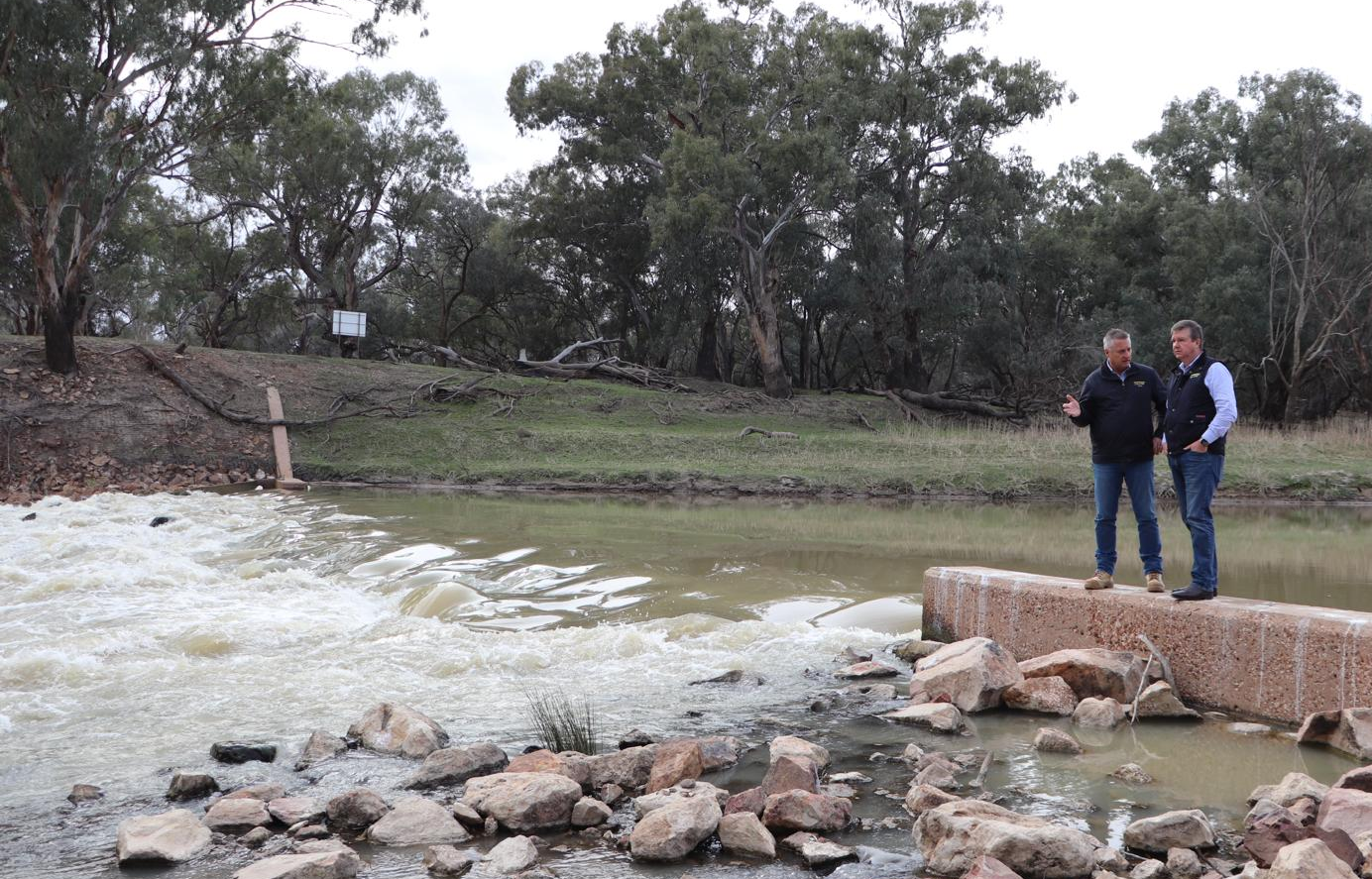
Caption: Jamie Chaffey and Ross Cadell at Louth Weir.
Nationals Senator for New South Wales, and Shadow Minister for Water, Emergency Management, and Fisheries and Forestry, Ross Cadell, said the lack of consultation had become a cornerstone of both levels of Labor Government.
“Water policy in this country needs to be clear and transparent,” Mr Cadell said.
“Instead, Labor has used the stroke of a pen on Macquarie Street to again muddy the waters, leaving regional communities with no trust in their elected officials.
“Our regional communities have lost faith in Government to listen, care, and respond.”
Under the new rules, northern Murray–Darling Basin irrigators will be restricted from accessing floodplain flows unless Menindee Lakes reaches 250 gigalitres.



The current threshold is 195 gigalitres.
“When you make changes of this scale, it is not just the Menindee Lakes who bear the consequences, it is every community in the Basin,” Mr Cadell said.
“Northern Basin communities have been experiencing years of regulatory conflict, litigation and administrative intervention from all levels of Government.
“What we need now is transparency, and meaningful consultation, not lip service from city-centric bureaucrats.
“I call on the State Labor Government to reverse its decision and commit to proper consultation with Basin communities,” he said.
Shadow Minister for Water Steph Cooke said the NSW Minns Labor Government must immediately release the valley-by-valley modelling and departmental advice underpinning their decision to lift the Menindee Lakes trigger from 195GL to 250GL of active storage.
Through a co-signed omnibus amendment to multiple water sharing plans, Ms Cooke said the Minister for Water and the Minister for Environment have altered the rules governing access to overland flows in the Gwydir, Macquarie, Cudgegong and Border Rivers systems.
Ms Cooke said the Government’s claim that the change does not affect allocations and therefore does not trigger compensation provisions under the Water Management Act demands a detailed public explanation.
“The Water Management Act establishes a clear statutory framework around allocation reliability and compensation where reliability is reduced beyond prescribed thresholds,” Ms Cooke said.
“If increasing the Menindee trigger reduces the frequency or duration of access to overland flows, the Government must demonstrate how that does not translate into reduced long-term allocation reliability.”
Ms Cooke said if the Government is confident the decision has no material impact on reliability, it should release the underlying evidence.
“That means publishing the valley-by-valley modelling, the projected change in access days, the long-term yield analysis and any assessment undertaken against the compensation provisions of the Act,” Ms Cooke said.
“This is not a minor administrative adjustment, it is a structural rule change affecting multiple Northern Basin systems.”
Ms Cooke also raised concerns about how the 250GL trigger has been calculated, including whether it is based solely on active storage and how dead storage within the Menindee Lakes system has been treated.
“These technical settings matter because small changes in modelling assumptions can have significant real-world consequences for Basin communities,” she said.
“Water policy must be transparent, evidence-based and provide long-term certainty for farmers and regional communities. Our farmers make multi-year cropping and capital-investment decisions based on predictable water conditions.
“Protecting communities and the environment is essential, but those objectives must be pursued transparently, with full disclosure of impacts and proper consultation.”
Ms Cooke is calling on the Ministers for Water and Environment to release all modelling, assumptions and departmental advice underpinning the 250GL active storage decision; publish valley-by-valley analysis of projected impacts on access frequency and long-term allocation reliability; confirm whether the decision has been formally assessed against the compensation provisions of the Water Management Act; and detail the consultation undertaken prior to the amendment.
“If this decision stacks up, the Government should have no hesitation in releasing the facts,” Ms Cooke said.
“Regional water users deserve certainty, transparency and accountability.”








0 Comments