

















GOONDIWINDI Regional Council mayor Lawrence Springborg said Council is carefully considering its options as the end of the financial year draws closer.
“As we enter the final quarter of this financial year and begin preparations for the next budget, Council is carefully considering its options,” Cr Springborg said.
“Like households and businesses across the country, we are experiencing significant price increases across a range of essential materials and services.
“Council is not immune to these challenges and, like many businesses, must make careful and considered decisions in response to changing and challenging conditions.
“While recent rising fuel costs are well known, Council is also facing anticipated supply issues and cost increases in numerous fuel by-products, such as polyvinyl chloride plastics, poly pipe, and bitumen.



























“These materials are critical to Council’s day-to-day operations – from maintaining an extensive road network to delivering essential water and sewerage services across the region,” he said.
Cr Springborg said Council’s priority is to minimise impacts on the community wherever possible and to continue delivering services and projects as close to “business as usual”.
“However, we must acknowledge that many of these cost pressures are outside of Council’s control and are being felt across all sectors,” he said.
“Council’s approach will be to continue to maintain a responsible financial position, operating on a cost-recovery model that aims to break even while continuing to deliver essential services and infrastructure, and to keep rate increases to a minimum.”
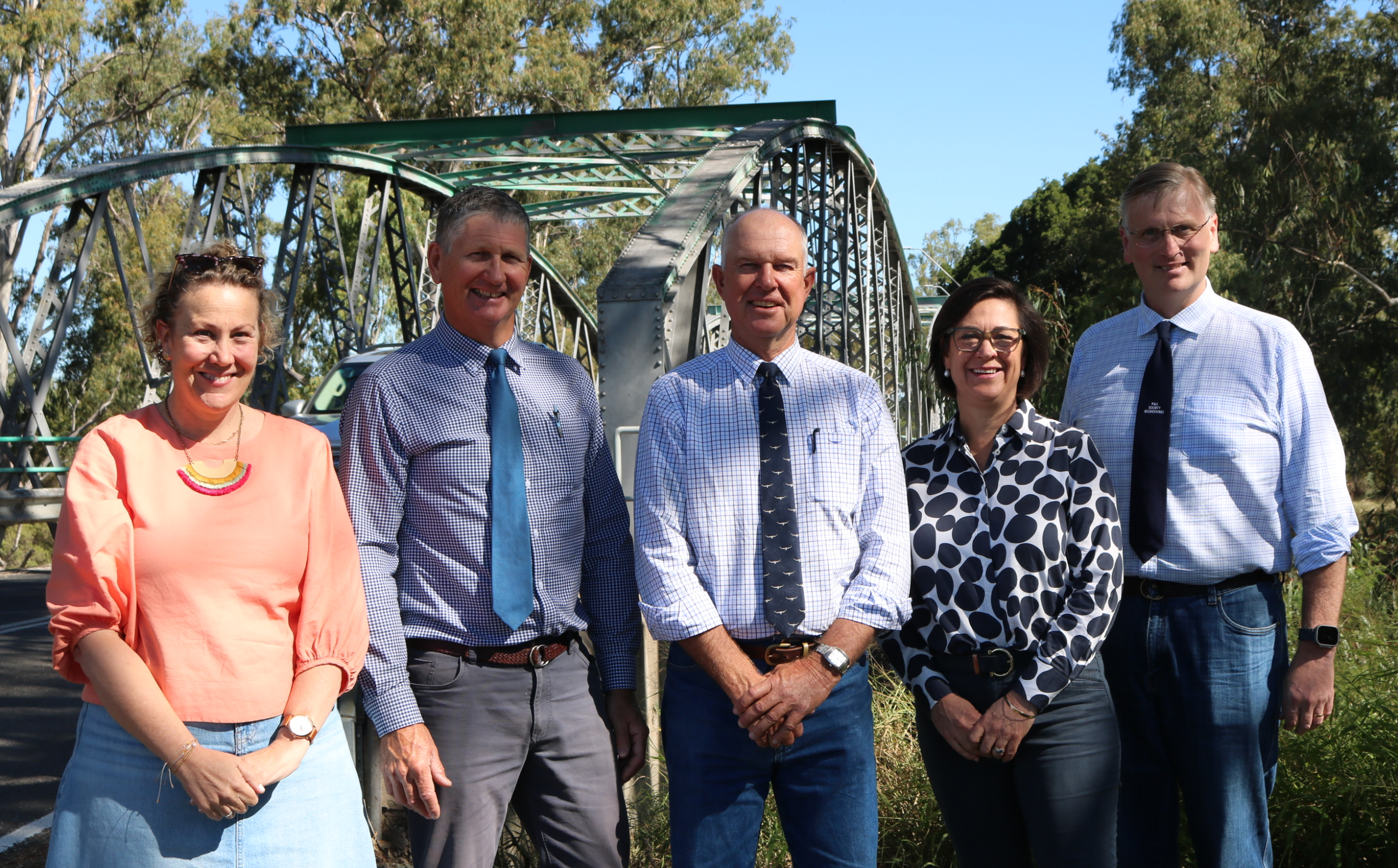
(from left) Cr Julia Spicer, mayor Lawrence Springborg, Minister Anthony Perrett, Cr Susie Kelly, and Minister James Lister at Goondiwindi this week.
Coexistence Queensland to visit the region
Meanwhile, Goondiwindi Regional Council has invited Coexistence Queensland to visit the region, with a public session likely to be held in the Inglewood area in July or August this year.
The Goondiwindi region is home to one of the transmission power lines connecting Queensland to the southern states, crossing the Dumaresq River downstream of Texas.
Coexistence Queensland is an independent statutory body established to help facilitate how communities and energy industries can work together beneficially.
They provide information on current policy settings, support impacted residents and businesses, and help people find advice.
“We are already seeing developments and proposals for renewable energy projects across our region and neighbouring LGAs – and can likely expect more in the future,” Cr Springborg said.



“It’s also important to note that local governments are not the decision-makers for larger-scale applications.
“However, Council does play a role in advocating on behalf of the community to minimise project impacts and we will continue to support opportunities for local economic growth when developments proceed, and not all proposals will come to fruition,” he said.
Cr Springborg said further details about the visit will be available closer to the time.
Coexistence Queensland is available to answer questions, and Goondiwindi Regional Council strongly encourages any landholders approached about hosting renewable energy projects to seek their guidance.
“Local businesses interested in the opportunities renewable energy may bring are also encouraged to get in touch and attend the upcoming information session,” Cr Springborg said.
For more information, visit Coexistence Queensland.
Minister for Primary Industries visits Goondiwindi
Cr Springborg welcomed Minister for Primary Industries, Tony Perrett, to Goondiwindi this week.
The visit provided an opportunity for productive discussions on key issues, including biosecurity and wild dog management and the importance of continued government support for enabling infrastructure such as roads.
“All of which are essential to a strong and productive agricultural economy such as ours,” Cr Springborg said.
“Minimising regulatory impacts on primary producers was also a key message to the Minister on behalf of our agricultural community.
“I also took the opportunity to reiterate the importance of the upcoming Murray–Darling Basin Plan review and the need for a clear, ongoing commitment from the Queensland Government to our region.
“From Council’s perspective, we remain strongly aligned with our local community and Border Rivers Food and Fibre on the critical importance of safeguarding the water resources that underpin our regional economy.
“Our position is that any Basin Plan changes must be grounded in sound science – not just change for change’s sake.
“Ours is, of course, a region shaped by both drought and flood, and this reality underscores the importance of preparedness for drought and natural disasters.
“After five, generally above-average seasons across our region, we are in a drying period.
“However, as we know from experience, Australia’s weather is notoriously variable and unpredictable. The only thing we can do is control our own actions and preparedness, whether individual or collective.
“Council continues to constantly remind our partners of the need for strong support and preparedness for natural disasters, ensuring our communities are ready to respond and recover,” Cr Springborg said.





0 Comments