




















REPRESENTATIVES from the NSW Premier’s Department, Bureau of Crime Statistics and Research and Moree bail accommodation program on Wednesday updated community members and stakeholders about the new bail facility, crime statistics in the region and place-based responses to the Moree Action Plan.
The meeting at Social Co House came a day after Youth Justice Minister Jihad Dib visited the new Maruma-Li Walaay youth bail accommodation facility now operating south of Moree.
At a corresponding media conference in Tamworth on Wednesday, Mr Dib announced a raft of Community Safety Investment Fund grants aimed at curbing the escalation of youth crime across New South Wales.
At Moree, BOCSAR executive director Jackie Fitzgerald presented crime statistics for the Moree region and David Anker from the Premier’s Department gave updates on the Moree Action Plan.
The $8.7 million Maruma-Li Walaay bail accommodation facility, now operational south of Moree near Gurley, aims to provide an innovative, culturally safe environment for young people on bail, with a focus on Aboriginal young people.


























The facility, a first of its kind in New South Wales, is operated by a consortium of local Aboriginal Controlled Community Organisations, with support from Youth Justice NSW.
Maruma Li Walaay will support young people to successfully comply with bail conditions; reduce the number of young people breaching bail; reconnect young people to education, training, and positive pathways; provide a culturally safe environment with access to cultural mentors and guidance; improve overall wellbeing and reduce the risk of reoffending; and strengthen relationships with family, kin, Elders, and community.
The program is designed to increase young people’s cultural and identity connections by engaging key community knowledge holders as well as strengthen their living and personal care, with healing and learning to change behaviours.
The bail facility will allow space for cultural program delivery, garden and bush medicine development areas, healing and yarning circles, with community stakeholders attending to provide on-the-job learnings through agriculture and other identified employment interest.
The public was given updates from project manager Adam See and Youth Justice NSW senior project officer Janice Raveneau.
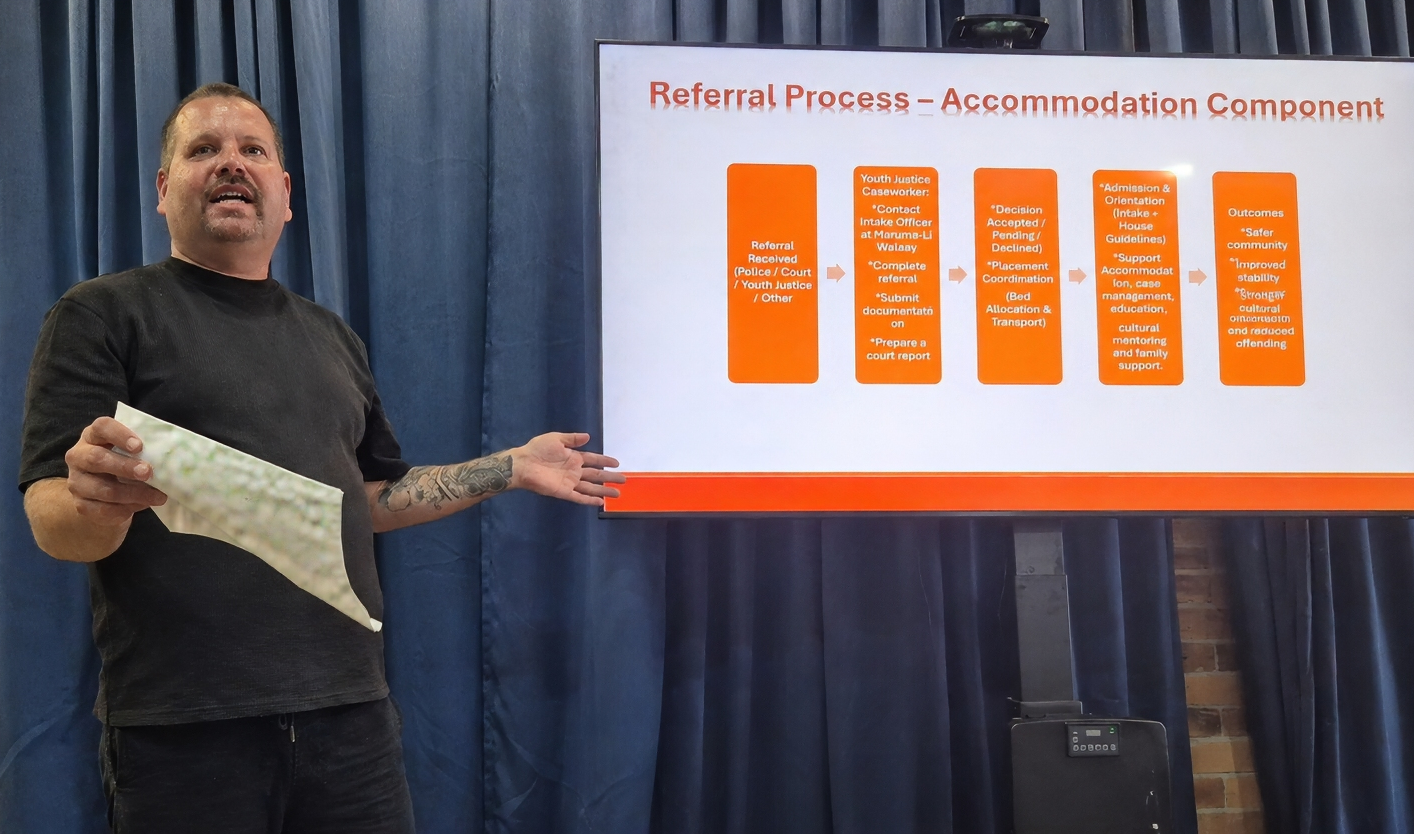
Maruma-Li Walaay youth bail accommodation facility project manager Adam See updates community members and stakeholders at Social Co House on Wednesday.
Mr See and Ms Raveneau have been working alongside a consortium of local service providers, including Pius X, Miyay Birray and SHAE Academy, to deliver the new facility.
Mr See told attendees Maruma-Li Walaay has been operational since March 30.
“We have done different things in multiple spaces,” Mr See said.
“Young people on bail that are in our age range can be self-referred or come through the justice system, or even through Youth Action meetings.”
Ms Raveneau told community members the bail accommodation has been in development since 2024, following the NSW Government’s commitment to place-based responses in Moree.


“Significant effort has gone into co-design and partnership development, and the timeframe reflects the complexity of establishing a culturally safe, regional and appropriate service that meets legislative, operational and community expectations,” Ms Raveneau said.
“Behind the scenes, extensive work has been undertaken to ensure the program is set up for long-tern success.
“This includes a comprehensive co-design process with young people, community members, elders and other stakeholders, establishment of a consortium of local Aboriginal organisations to deliver the program, and ongoing efforts to secure a suitable property.
“(the work includes) navigating planning and zoning requirements and ensuring it meets safety, license and compliance requirements,” she said.
“We have recruitment of key staff, including the appointment of a project manager, youth officers and acting staff.
“We’ve also developed a service model, operational policies, referral pathways and government structures aligned with Youth Justice expectations.
“This preparatory work has been critical to ensuring a responsible and supportive commencement,” Ms Raveneau said.
Maruma-Li Walaay, currently with one client, can accommodate up to four young people at a time who are on police or court bail that cannot be safely accommodated at home, ensuring they have a suitable, supportive and supervised place to stay.
Minister for Youth Justice, Jihad Dib, said Community Safety Investment Fund grants will support young people and their families, while strengthening community safety across New South Wales.
“We know any time spent in custody can have a lasting negative effect on young people, which is why bail accommodation facilities like Moree’s new Maruma-Li Walaay are so important,” Mr Dib said.
“By providing young people in north-west New South Wales with safe, secure and supervised accommodation, the courts and police have options that do not involve custody and can help reduce the risk of reoffending.
“When young people are given the right support early, it can change their path, and that’s exactly what these local organisations are working to do,” he said.
“We’re helping both young people and their families to re-engage with education, training or employment through programs which are locally designed and delivered.
“Long-term, we want to see fewer young people interacting with the criminal justice system as we work to protect community safety by delivering consequences as well as opportunities for young people to change course.”
Secretary of Department of Communities and Justice, Michael Tidball, said the Community Safety Grants scheme is an important way to connect local providers with at-risk young people to help them before they come into contact with the justice system.
“By keeping these programs locally focused we are empowering communities to take action to help their local young people and make the communities safer,” Mr Tidball said.
“Working more closely with Aboriginal Controlled Community Organisations is a major part of the Department of Communities and Justice program to provide services for Aboriginal young people and other at-risk youth.
“Maruma-Li Walaay shows how effective a partnership between the Aboriginal community and Government can be,” he said.






0 Comments