




















State-of-the-art temporary fish passage technology is being trialled in the Lower Darling-Baaka River near Menindee in western New South Wales.
The goal of Fishheart is to test options to connect the northern and southern basin and reduce the accumulation of fish, as part of the NSW Government’s response to the Office of the NSW Chief Scientist and Engineer (OCSE) independent review into the March, 2023 mass fish kill.
Australian native fish need to migrate to feed, breed and seek new habitat but due to the introduction of barriers to fish passages, like dams and weirs, fish migration pathways have been impacted.
Currently in the Lower Darling-Baaka, fish can only migrate upstream as far as Lake Wetherell and Menindee Main Weir.
The Fishheart unit is a floating hydraulic fishway system designed to assist fish moving over existing barriers.

























Construction to install the Fishheart unit to the Lake Wetherell outlet regulator commenced in December.
Work continued over summer, with the technology being lowered into the Lower Darling-Baaka River in late January. Calibration and testing of the Fishheart is currently underway.
The Fishheart unit works by attracting fish into the fishway and then using Artificial Intelligence to detect and collect fish in the chambers, counting fish, gathering data before moving fish up and over barriers like the Lake Wetherell outlet regulator.
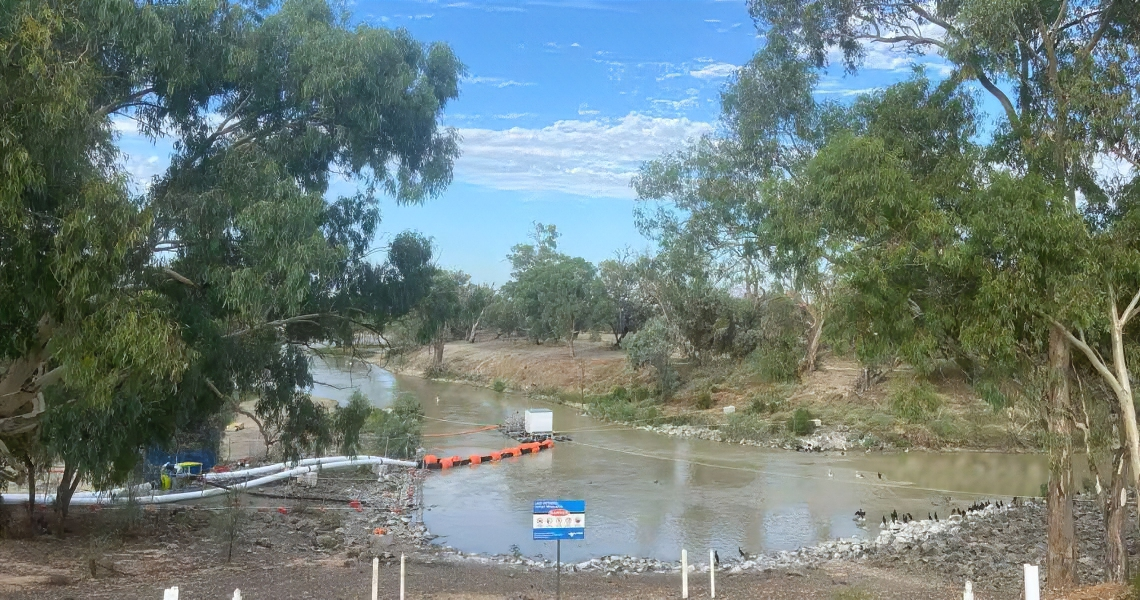
State-of-the-art temporary fish passage technology is being trialled in the Lower Darling-Baaka River near Menindee in western New South Wales.
This is the first time that this innovative technology will be trialled at this scale on Australian inland freshwater fish and builds on Fishheart’s work in Europe and the United States that has shown plenty of promise.
The aim of the project is to test options to connect sections of the river, thereby helping move some fish out of the Menindee town weir pool to complete their life cycle and reducing the biomass and associated risks for water quality and fish kills.
Scientists from the Department of Primary Industries and Regional Development will conduct the monitoring program, using underwater sonar and video capture technology, plus trapping activities under appropriate permits.
Minister for Agriculture and Regional NSW, Tara Moriarty said this is the first time that this technology will be trialled under Australian conditions at this scale and on native inland freshwater fish.
“It demonstrates the commitment of the Minns Labor Government to address environmental issues using innovative approaches, especially in western New South Wales,” Ms Moriarty said.
“While there is no one size fits all solution to restore fish passage in the Lower Darling-Baaka River or the Menindee Lakes system, this project aims to use innovative science, data and infrastructure as we promised to do.
“Construction has been progressing through very hot days out at Menindee and we are grateful to all the personnel for their efforts in ensuring the fishway can get operational as soon as possible.



“The Fishheart will be trialled for three breeding seasons, to measure its effectiveness in Menindee. But overseas experiences provide strong indicators for success, for moving fish through the fishway safely and hopefully reduce the risks of future fish kills in the Lower Darling-Baaka.”
Minister for Water Rose Jackson said Fishheart was an innovative infrastructure solution.
“We pledged to take decisive action on water quality in the Darling-Baaka to improve fish health and we are delivering on this promise, with a six-month progress report now available to show the community where we are up to,” Ms Jackson said.

“So far, we have developed new water quality triggers, overhauled our emergency response plans, continued to upgrade monitoring and added additional resources while also exploring state-of-the-art infrastructure solutions such as the tube fishway and microbubble technology.
“I’m encouraged by the progress in a short space of time, which the chief scientist himself has acknowledged publicly, but there is still a lot of work to be done.
“The reality is this is an incredibly complex river system with significant challenges that won’t go away overnight, but we are in a much stronger position to respond to changing conditions than ever before, and we are undoubtedly moving in the right direction,” she said.
Media Release







0 Comments