




















MOREE Aerodrome welcomed a Royal Australian Air Force C-130J-30 Hercules aircraft on Friday afternoon as part of a routine training activity, highlighting the aerodrome’s ongoing role in supporting Defence and large-aircraft operations.
The aircraft conducted circuits and touch-and-go training, a standard flying exercise used to maintain pilot proficiency.
Senior aerodrome reporting officer Kingsley Counsell said the activities were pre-planned and co-ordinated with aerodrome staff, with all operations were conducted safely and in accordance with established aviation procedures.
“Visits like this demonstrate how Moree aerodrome can safely support large aircraft operations and continue to play a role in Defence training and national resilience,” Mr Counsell said.
The flight was not related to an emergency or incident, and there was no disruption to scheduled passenger services.
































The aircraft operating at Moree Friday was a RAAF C-130J-30 Hercules, callsign Trojan 07, crewed by the standard three-person flight crew – pilot, co-pilot and loadmaster.
On initial arrival, the aircraft completed one touch-and-go landing before departing the immediate aerodrome area to conduct further training to the west of the airport, operating below 1000 feet above ground level.
The aircraft returned to Moree about one hour later and completed three additional circuits and touch-and-go landings.
“This is a common training sequence used to practise approaches and landings,” Mr Counsell said.
“The aircraft then conducted a full-stop landing and taxied to the main apron, where it remained on the ground for nearly two hours before departing to continue its tasking.
C-130 aircrew are well known for being approachable, professional, and generous with their time. During ground stops at Moree, the crew regularly invite airport staff and members of the public present at the time to view the aircraft externally, ask questions, and take photographs with the aircraft and crew.
For security reasons, internal photography is not permitted, which is standard policy across military aircraft.
“This approachability has made the Hercules a favourite among aviation enthusiasts and a familiar sight at regional aerodromes,” Mr Counsell said.
The C-130 Hercules is a frequent visitor to Moree, operated by No. 37 Squadron from RAAF Base Richmond.
In 2025, C-130 aircraft operating through Moree played an important role in disaster relief operations, including supplying south-east Queensland when multiple airports were closed due to severe weather.
Airport staff have formally advised No. 37 Squadron that Moree Aerodrome is always available and welcoming, and the squadron continues to take opportunities to operate in the region whenever training or operational requirements allow.






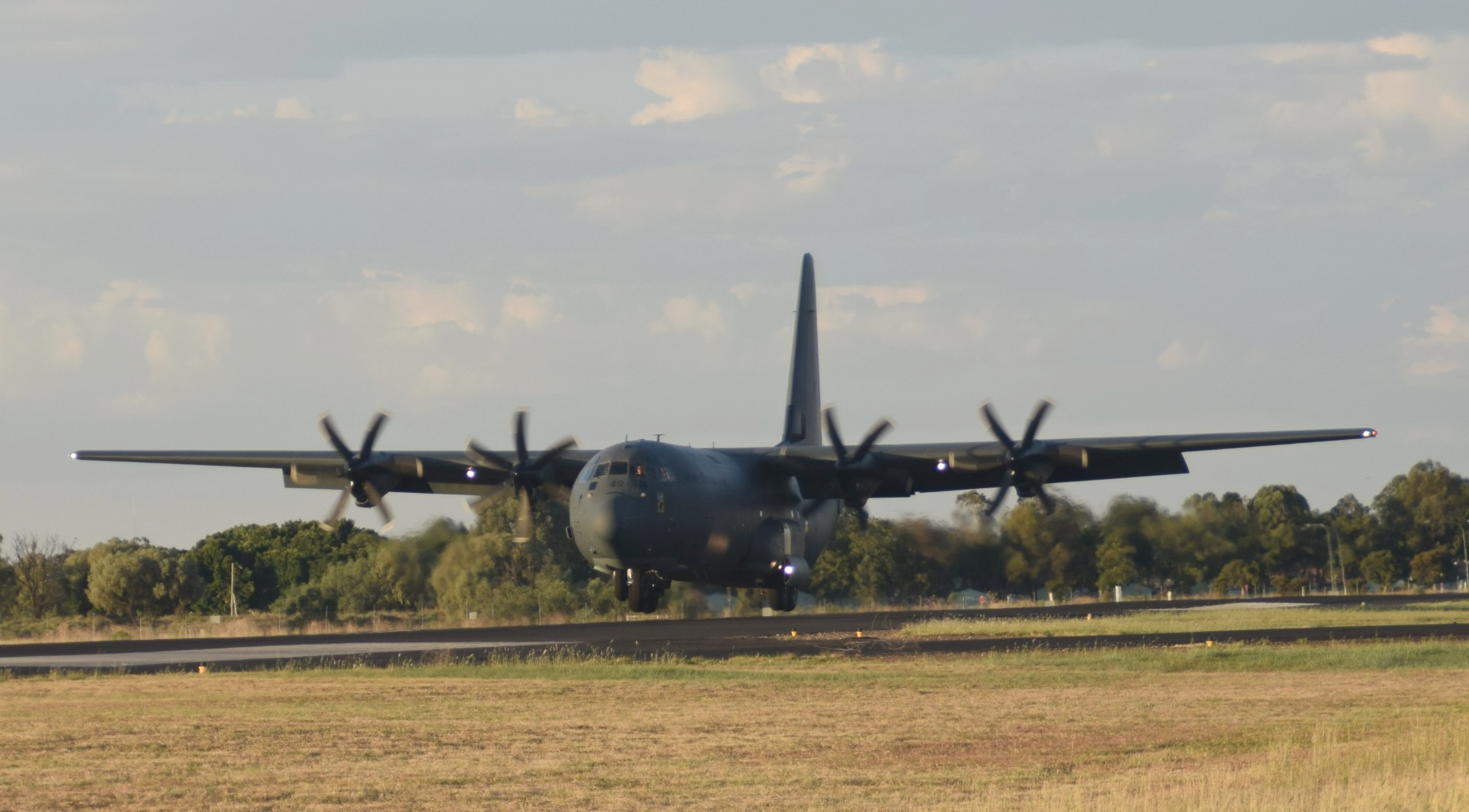
The Royal Australian Air Force C-130J-30 Hercules aircraft at Moree Aerodrome last week (Image Supplied).
About the C-130J-30 Hercules
The C-130J-30 Hercules is a medium-sized tactical airlifter designed to operate in demanding environments.
It is capable of delivering cargo to short or unsealed runways, conducting airdrop operations, and supporting a wide range of military and humanitarian missions.
The Royal Australian Air Force operates a fleet of 12 C-130J-30 aircraft, delivered between 1999 and 2001.
The aircraft forms a cornerstone of Australia’s airlift capability and is routinely used for personnel and equipment transport; humanitarian and disaster relief; search and rescue support; and medical evacuation.
The C-130J-30 operates alongside other RAAF airlifters, including the C-27J Spartan and the larger C-17A Globemaster III, allowing flexibility across different mission types.
A C-17A Globemaster III was at Moree Aerodrome on Thursday.
Ongoing upgrades the C-130 have enhanced communications, information-sharing, and operational endurance, ensuring the aircraft remains effective in modern operating environments.
C-130J-30 Hercules – Key Specifications
Manufacturer: Lockheed Martin
Role: Tactical and medium air transport
Crew: Pilot, co-pilot, loadmaster
Length: 34.4 metres
Wingspan: 40.4 metres
Height: 10.1 metres
Maximum weight: 79,378kg
Maximum payload: approx. 19,500 kg
Engines: Four Rolls-Royce AE2100D3 turboprop engines
Cruise speed: approx. 643 km/h
Range: up to 6852 km (no payload)
Service ceiling: 40,000 feet
The aircraft can carry up to 124 passengers, 88 paratroopers, 84 stretcher patients plus four medical attendants, and up to 19,598 kg of cargo.
The C-130 is also fitted with self-protection systems to enhance survivability during operations.




0 Comments