






















EVERYTHING is rolling along smoothly – right on schedule, with no hiccups.
Road trains are arriving on-farm to be loaded. It’s been a good season, a great season.
The place is a hive of activity – then the power fails and everything comes to a grinding, deafening halt.
It’s every farmer’s worst nightmare, but Joff Cannington and his team at Compressed Air Light and Power in Moree has the solution.
“Every farm has its own grid transformer, and when there is a power failure, everyone goes to the transformer to see if it’s a ‘just me’ scenario or whether the failure is affecting everybody in the district,” Mr Cannington said.



































“More often than not, it’s everybody. There’s usually some sort of issue with infrastructure or there may have been a wind or storm event – something that’s cut the power.
“We can position a diesel-powered generator with an automatic transfer switch at or near the base of the transformer pole, with the two connected,” he said.
“Without getting to technical – we can also power a service poles downstream from the transformer pole if that transformer pole is poorly located, for example in a floodway or house garden.
“The power runs through the transfer switch from the grid, and the switch determines when the grid is giving power or when the generator needs to start.
“When the power drops, the generator will automatically start, make the connection, and send power to where it needs to go.
“There is nothing worse than having empty trucks lined up and there’s a power failure – the pressure can be really on,” he said.
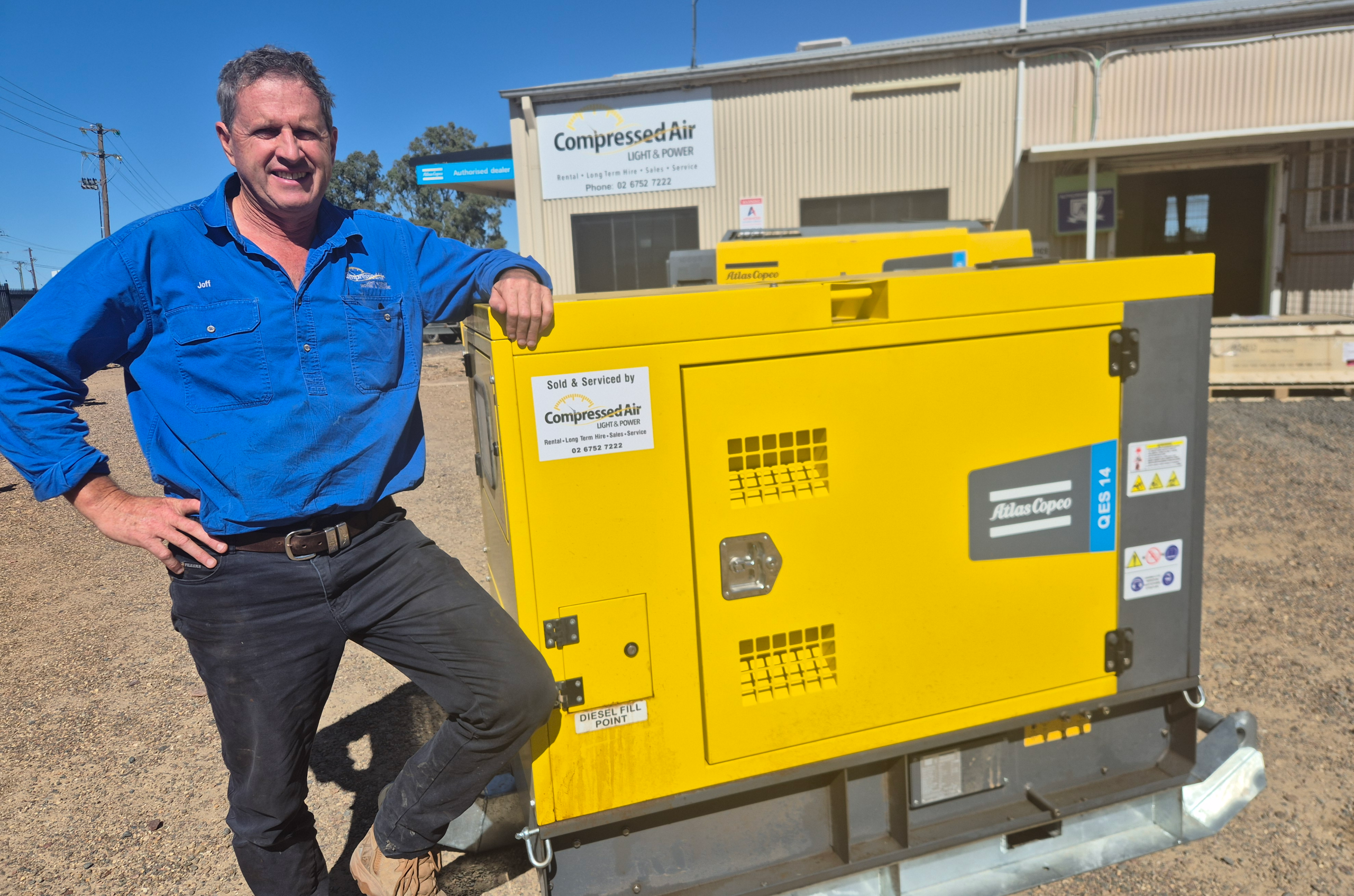
Joff Cannington and a diesel-powered generator – perfect for when power failures hit the farm.
Mr Cannington said a huge generator is not generally needed to run silo outloaders or households.
“Business houses and farmers aren’t trying to run the entire platform, but just what is needed at that particular time when the power cuts out,” Mr Cannington said.
He says a permanent, on-site generator at or near the base of the power pole housing the transformer, will save farmers thousands of dollars in downtime and lost productivity.
“We’re talking about $16,000 and upwards for a diesel-powered generator, and that’s not expensive in terms of what can be saved,” Mr Cannington said.





“The generator will run continuously for about 50 to 70 hours. To run a normal-sized house and shed, the generator will use about two or three litres of diesel per hour.
“With properties and farms, where there are staff and people on night shift who want to sleep through the day, having one of these generators will keep the entire operation running smoothly with no setbacks because of power failures.
“Households and living quarters, or coolrooms and cooking facilities aren’t affected,” he said.
Mr Cannington said installation was straightforward.
“Generators are generally easy to install and we have all the technical support needed to maintain the machines,” he said.
“We work with all the local electricians and there are a couple of layers of tech support behind the equipment.”
He said there are a range of generators to suit all on-farm applications and needs.
“There is a choice of sizes, depending on how many uses or applications one has, and how many power-consumed assets are powered,” Mr Cannington said.
A calculator on the Compressed Air Light and Power website HERE will configure the amount of power needed for any particular site and the size of the generator needed.
An alternative method to determine size is look at the size of the circuit breaker – amps – in the power board at the transformer
“It’s an automated solution with consistent, silenced, stable power that will turn on automatically if there is a power failure,” Mr Cannington said.
“We’re not trying to replace the grid; we’re applying the basics to keep on-farm and business continuity going and the cashflow rolling.”
Mr Cannington said the entire switch-over process when a power failure hits, is fully automatic.
“When the power comes back on, the generator will switch off,” he said.
“The make-or-break transfer switch will ‘break’ the grid and ‘make’ the generator start. It will also monitor the grid, and as soon as the grid comes back on, will reconnect.
“There is a delay period of about four minutes to make sure the grid stays on and that it’s not a brown-out.
“The generator will then cool down for about a minute before turning itself off. It remains in standby mode with the ignition switched on, ready to go when needed,” Mr Cannington said.
Compressed Air Light and Power is not only the home of on-farm generators.
The Moree-owned agribusiness on Tycannah Street, a major regional dealer specialising in Atlas Copco, Pilot Air, and custom-built units for agricultural applications, also supplies a range of air compressors, LED light towers, diesel, electric and submersible pumps, and a wide range of self-bunded fuel tanks.
“We also custom-build combination packs for trailers and service trucks to clients’ specifications,” Mr Cannington said.
Compressed Air Light & Power
Generator size and output calculator: https://www.calp.net.au/services/purchasing
Phone: 1800 002257
Address: 55 Tycannah Street, Moree, NSW, 2400
Email: [email protected]
Facebook: https://www.facebook.com/compressedairlightpower
Instagram: https://www.instagram.com/compressedairlightpower/?hl=en







0 Comments