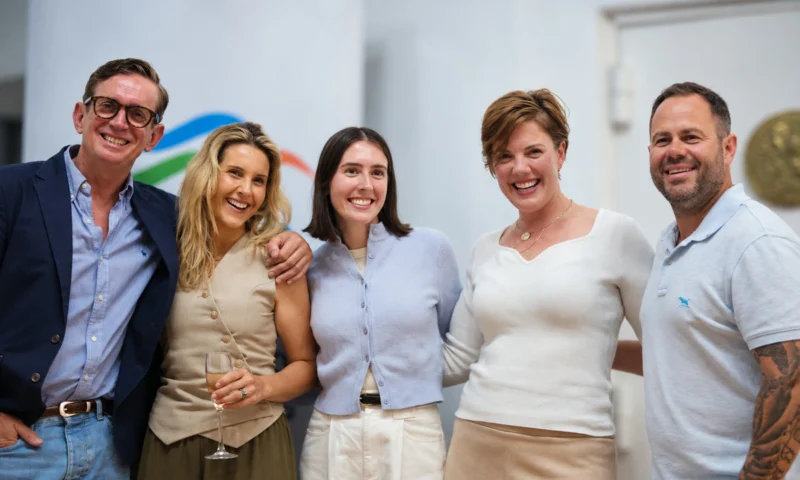
At Business Beyond Burnout inside the Bank Art Museum Moree, from left, Toby Osmond, Sam Burgess, Amy Carrigan, Helena Doran and Tyler Macey. Photo: Moree Online News.
Helena Doran was running a business built around helping other people relax, but her own life had become anything but relaxing.
She was exhausted, in pain and struggling to manage the demands of being a business owner, employer and mother. Even going to the pub had become difficult. She worried that people who knew her as the owner of Bella Santé Skin & Body Centre would judge her if they saw her enjoying herself.
For a long time, staying home seemed easier than risking what others might think.
Her experience was one of three very different accounts shared at the Moree Chamber of Commerce’s Business Beyond Burnout evening on Friday 16 October 2026. Held inside the Bank Art Museum Moree as part of Small Business Month, the event brought local business owners together to talk about the pressures of running a business and what keeps them going.
While the evening focused on wellbeing, the conversation went beyond managing stress. It raised questions about finding staff, supporting local shops and the role businesses play in keeping people connected.
For Ms Doran, the biggest challenge had been learning that owning a business did not mean she had to lose herself in it.
When she bought Bella Santé, she tried to run it the way its previous owner had. She admired what that woman had built and wanted to do things just as well, without recognising the years of experience and mistakes that had helped her predecessor get there.
Moving premises did not solve her problems, and the arrival of COVID made them worse.
“I can’t be what everyone wants me to be,” she said.
She had been trying to meet everyone’s expectations, from clients and employees to her own family. When staff left the business, she took it personally, questioning why people would want to leave when she believed she was doing her best for them.
Eventually, she began to understand that she could not control everyone around her. What she could change was how she responded to them and how she looked after herself.
The effect on her family was particularly difficult to confront. She described being in constant pain, spending money on physiotherapy and chiropractic treatment, drinking to numb how she felt and sleeping until the last possible moment.
Mornings became a frantic rush to get her children ready, often ending in frustration. She realised she was telling them to look after themselves while failing to set that example in her own life.
A client encouraged her to attend a personal development workshop, although she was reluctant to go.
“Let’s just say it took her eight months to convince me,” Ms Doran said.
She credited the experience with helping her understand some of the beliefs she had carried since childhood and why she placed so much pressure on herself.
Her routine is now very different. She gets up at 5am, attends the gym at 6am and arrives at work early enough to prepare for her first client at 9am.
She has also learned to leave one client’s worries behind before welcoming the next. She described taking a breath between appointments and imagining a sheath passing over her, allowing her to begin each treatment with a clear mind.
Those changes have carried into her personal life.
“I now don’t have a mask that I hide behind,” she said.
She no longer feels she must behave like a different person outside work to protect the reputation of her business.
While Ms Doran had been learning how to manage the personal demands of running a business, Georgie King described another challenge familiar to regional employers: finding enough people to do the work.
Ms King and her husband Roly own Print Anything and Hip Pocket Workwear & Safety North West, with businesses operating across Moree, Narrabri and Inverell.
Staff shortages have forced them to look beyond Moree. One employee travels from Narrabri each week to run the Moree shop, while Ms King is trying to sponsor a graphic designer from Argentina.
She said the sponsorship process could cost $20,000, with no refund if the visa application was unsuccessful.
For a small business, it is a substantial amount of money to risk simply to fill a position.
But when asked what motivated her to keep going, Ms King did not talk about profits or expanding the business. She talked about driving through town with her children.
She still points out signs and other printing jobs completed by her team, proud to show them something the business has created.
“I still get a lot of pleasure out of seeing our finished work,” she said.
That pride extends to the events and organisations the business supports. Print Anything has been involved in activities including Run the Plains, and Ms King said she enjoys being more than a sponsor.
When she supports an event, she likes to help make it happen. Seeing people turn up and take part makes the effort worthwhile.
Moree is also home. Her children grew up here, her mother still lives here, and she has spent years involved in local organisations and community events.
That connection makes it difficult to watch other businesses close.
Ms King said she wanted major local employers and their staff to give Moree businesses an opportunity before automatically buying online.
She acknowledged local retailers also needed to adapt to changing shopping habits, including improving their online services. But she believed shoppers had a part to play in keeping local businesses operating.
Her request was simple: “give the locals a chance”.
Her concerns were not only about losing sales. If people stopped supporting local businesses, she feared the shops themselves would disappear.
It was a concern shared by Yaama Ganu Gallery director Toby Osmond, although he approached it from a different direction.
After spending about 20 years away from Moree, including working in hospitality businesses, Mr Osmond returned to the town he had always considered home.
He had enjoyed the busy, unpredictable nature of hospitality when he was younger. The chaos had been part of the attraction. As he grew older, however, he recognised that anxiety and constant demands needed to be managed rather than simply endured.
Exercise has become part of his routine, along with a practical way of dealing with one of the biggest distractions of modern working life: his phone.
He described leaving it in the car when he arrived at work, giving himself an hour to concentrate on emails and other tasks without constantly being interrupted.
Mr Osmond remembered Saturday mornings when he came into Moree from his family’s farm. The main street was busy, and visiting the shops meant running into people he knew. Those businesses were “where we also checked in on each other”, he said.
He contrasted that with seeing people sitting in their cars outside Woolworths, looking at their phones. A shopping trip that once involved half an hour of conversations could now pass without anyone stopping to talk. He worried about what was lost when those ordinary chances to find out how someone was doing disappeared.
It was another side of the concern Ms King had raised about businesses closing. A shop provides jobs and goods, but it can also be somewhere people see familiar faces and keep in touch. For Ms King, that connection is part of the pleasure of seeing signs her team has made around town and helping at local events.
There was a striking difference between Mr Osmond’s memories and Ms Doran’s experience. Being recognised in Moree had once made her anxious enough to avoid going out. For him, those everyday encounters were part of what made the town feel like home.
Ms Doran had found ways to protect her wellbeing without withdrawing from the people around her. Ms King was still tackling staff shortages while asking residents to give local businesses a chance. Mr Osmond was thinking about the conversations that used to happen along the main street.
Each had a different reason to keep going. And each, in their own way, described how much more a business can mean to a town than the work done behind its doors.