






















THE call to place a Heritage NSW Blue Plaque in Moree to memorialise the 1965 Freedom Ride edged a step closer at a special meeting in Moree on Thursday.
Communities across New South Wales were last year asked which towns and specific locations should be commemorated with a plaque to create a Freedom Ride Blue Plaque Trail – and local residents were encouraged to nominate Moree.
Suggestions for a suitable location for a Blue Plaque include Moree Artesian Aquatic Centre on Anne Street – previously known as Moree Bore Baths – and Moree War Memorial Hall on Balo Street.
Heritage NSW Blue Plaques project officer Adam Stone, senior project manager Maruschka Loupis and assistant project manager Aimee Lee met with Moree elders, including Barry and Elaine Sampson, Dianne Creighton, Val Pitt, Vivianne Duncan and Donnella Smith, to talk about the significance of the Freedom Ride in Moree.
Mr Stone said Blue Plaques are an important part of the Heritage NSW structure.

































“We get to tell the stories of what happened in Australia, whether they be Aboriginal stories, colonisation stories, or stories about what happened historically in New South Wales,” Mr Stone said.
“We are very fortunate to be able to tell these stories, and tell them truthfully.”
The Blue Plaques NSW program is a $5 million Heritage NSW initiative that installs plaques at publicly accessible locations to honour significant people, events and stories that shaped the state’s history. Inspired by a similar program in London, plaques commemorate diverse, often hidden, local history – from pioneers to social movements.
There have been more than 60 plaques unveiled across New South Wales since 2021.
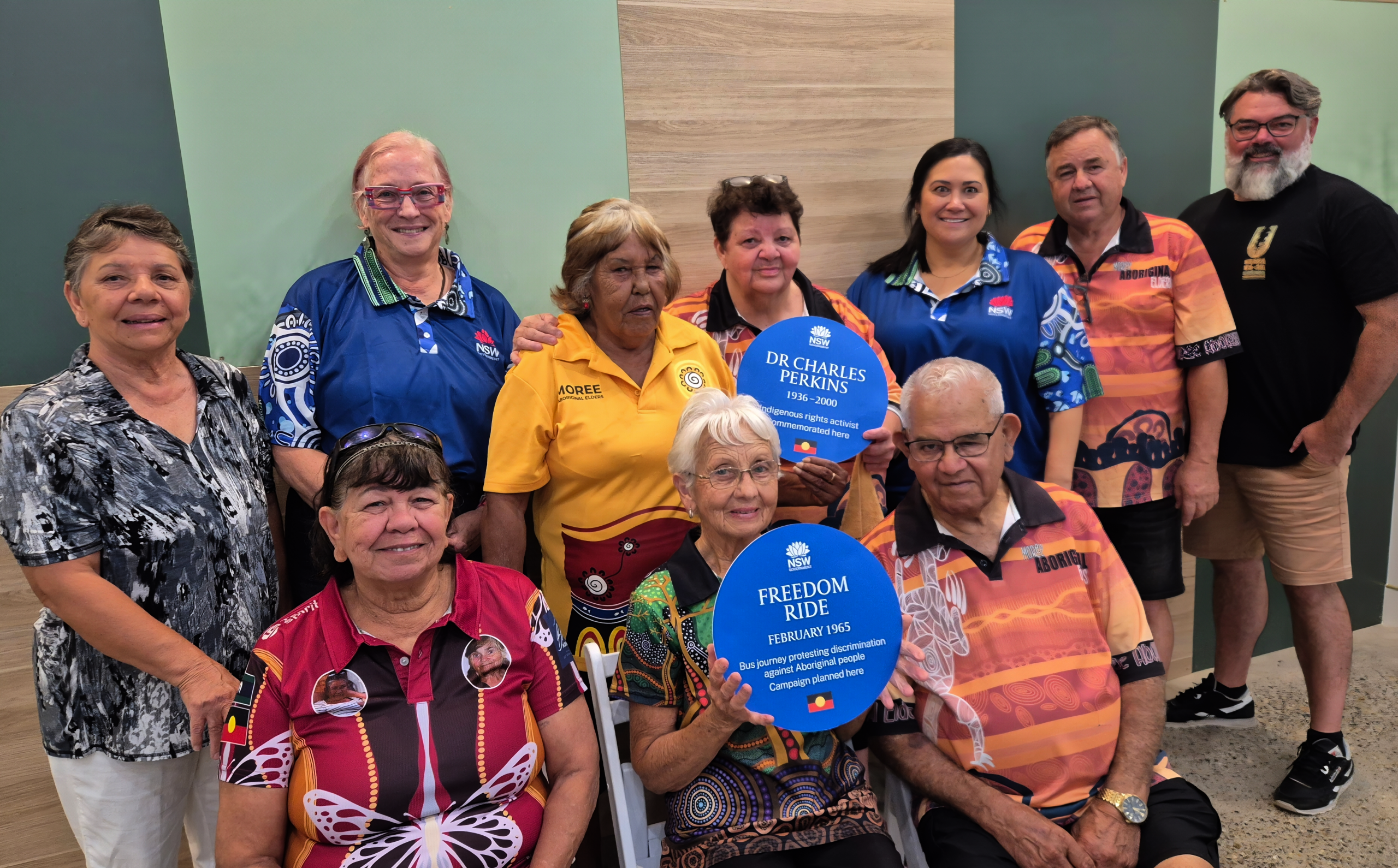
At back (from left) Dianne Creighton, Maruschka Loupis, Val Pitt, Donnella Smith, Aimee Lee, Glen Macey, Adam Stone, with seated at front (from left) Vivianne Duncan and Elaine and Barry Sampson.
A NSW Blue Plaque was unveiled in Walgett 12 months ago to commemorate the 60th anniversary of the 1965 Freedom Ride.
Located in the Freedom Ride Memorial Park, the plaque recognises the role Walgett played in the fight led by Charles Perkins and University of Sydney students against racial injustices.
The call is now on to place a Blue Plaque in Moree.
Moree Artesian Aquatic Centre, heritage listed in 2013 because of its important role in the history-defining 1965 Freedom Ride, is shortlisted as a possible site.
Also suggested is Moree War Memorial Hall, where important decisions were made and papers signed to overturn a 1955 ordinance adopted by Moree Municipal Council.
The 1955 bylaw denied Aboriginal people entry to the local pool and town hall.






In part, the ordinance stated “no person, being a full-blooded or half-caste aboriginal native of Australia, or being a person apparently having an admixture of aboriginal blood, shall use or occupy, or be present in or upon, or be allowed or permitted or invited to use or occupy or be present in or upon the premises of the Council known as the Memorial Hall, or in or upon any of the buildings or places ancillary thereto, or be present in or upon the premises of the Council known as the Bore Baths, or in or upon any of the buildings or places enclosed therewithin”.
The council ordinance was scrapped 10 years later after University of Sydney students, led by Charles Perkins, embarked on the Freedom Ride across much of New South Wales.
Freedom Riders picketed Moree Bore Baths in protest against the council ruling.
Students met with Moree mayor Bill Lloyd and alderman Alf Jones. Soon after, the students secured the entry of more than 20 Aboriginal children to the pool.
The Freedom Ride represents an important chapter in the struggle for Indigenous civil rights in Australia and contributed to a landmark 1967 referendum, when more than 90 per cent of Australians voted ‘yes’ to give Indigenous Australians full rights as citizens.
“The Freedom Ride was the start of reconciliation and the start of people seeing, hearing and listening and actually saying ‘hang on, that’s not right’,” Mr Stone said.
“It was one of the first times in Australian history that people saw what was happening and said ‘this shouldn’t be the case’.
“And if it wasn’t for those 29 people who jumped on a bus out of Sydney University and started their trail, potentially the world we live in today could have been substantially different,” he said.
Thursday’s meeting at Social Co House enabled the Heritage NSW team to hear stories from locals, and what the 1965 Freedom Ride meant to Moree.
“We wanted to hear from locals what the Freedom Ride meant to them as kids, or hear the stories that have been passed down from generations before,” Mr Stone said.
“We came to Moree to connect with the community and to hear the stories.
“The 1965 Freedom Ride was a really important part of Moree’s history, and Australia’s history.”
The program has placed plaques across New South Wales commemorating entertainment and the arts, architecture and construction, community and philanthropy, travel and transport, and significant events that shaped New Soth Wales.
The Freedom Ride Blue Plaque Trail will capture the stories and events that took place at the key stops on the Freedom Ride journey and join with the existing Freedom Ride blue plaques at the Wayside Chapel in Potts Point and Walgett’s Freedom Ride Park.
“New South Wales has had Blue Plaques for four or five years and to date we have more than 60 around the state,” Mr Stone said.
“They can be seen in Sydney and there are a lot in outback communities as well.
“We’re trying to grow them, and one of the ways to do that is through the 1965 Freedom Ride Trail,” he said.
More details about the Blue Plaque Trail is available at Blue Plaques 1965 Freedom Ride.
Words and Image: Bill Poulos







0 Comments