



















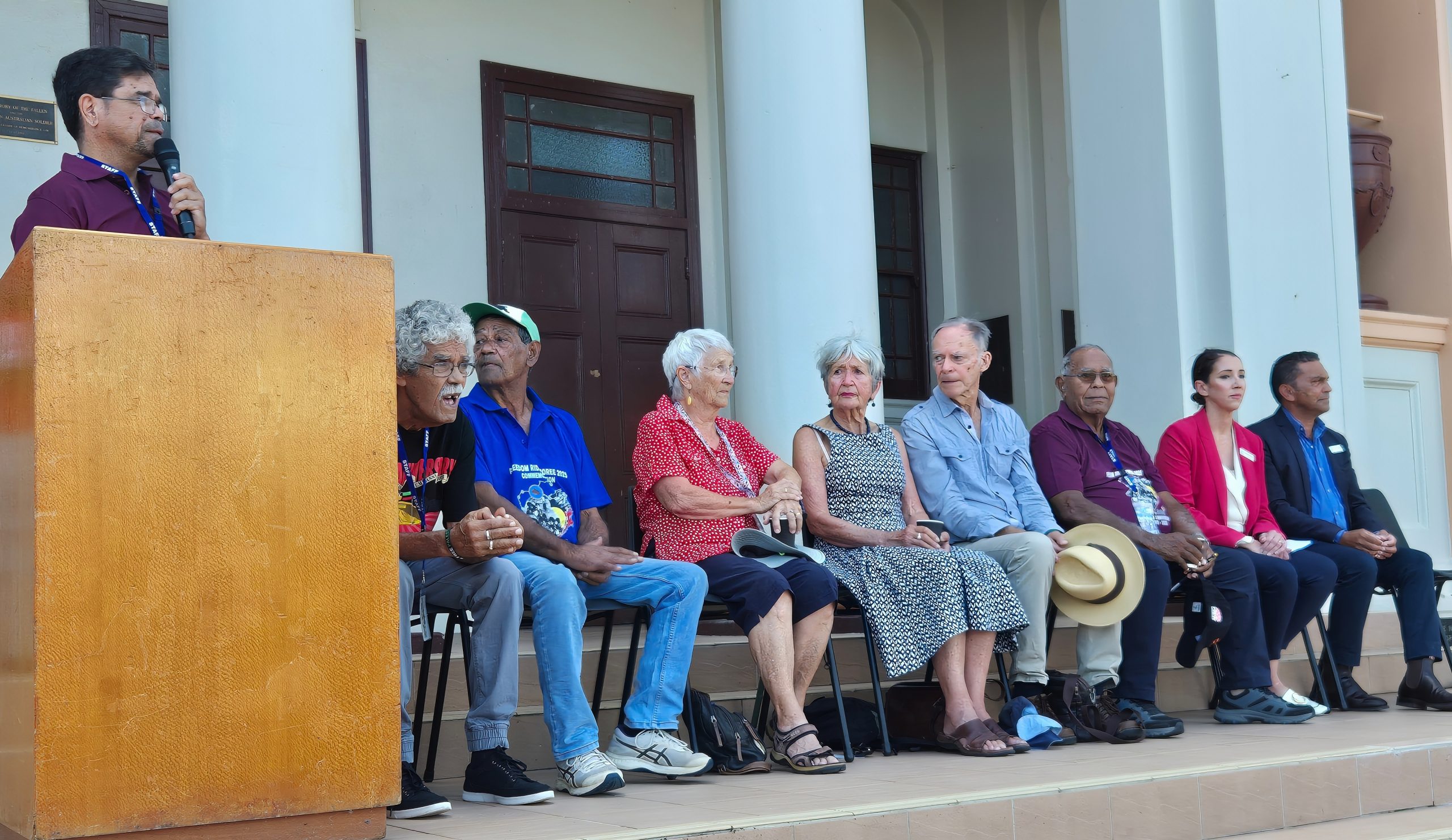
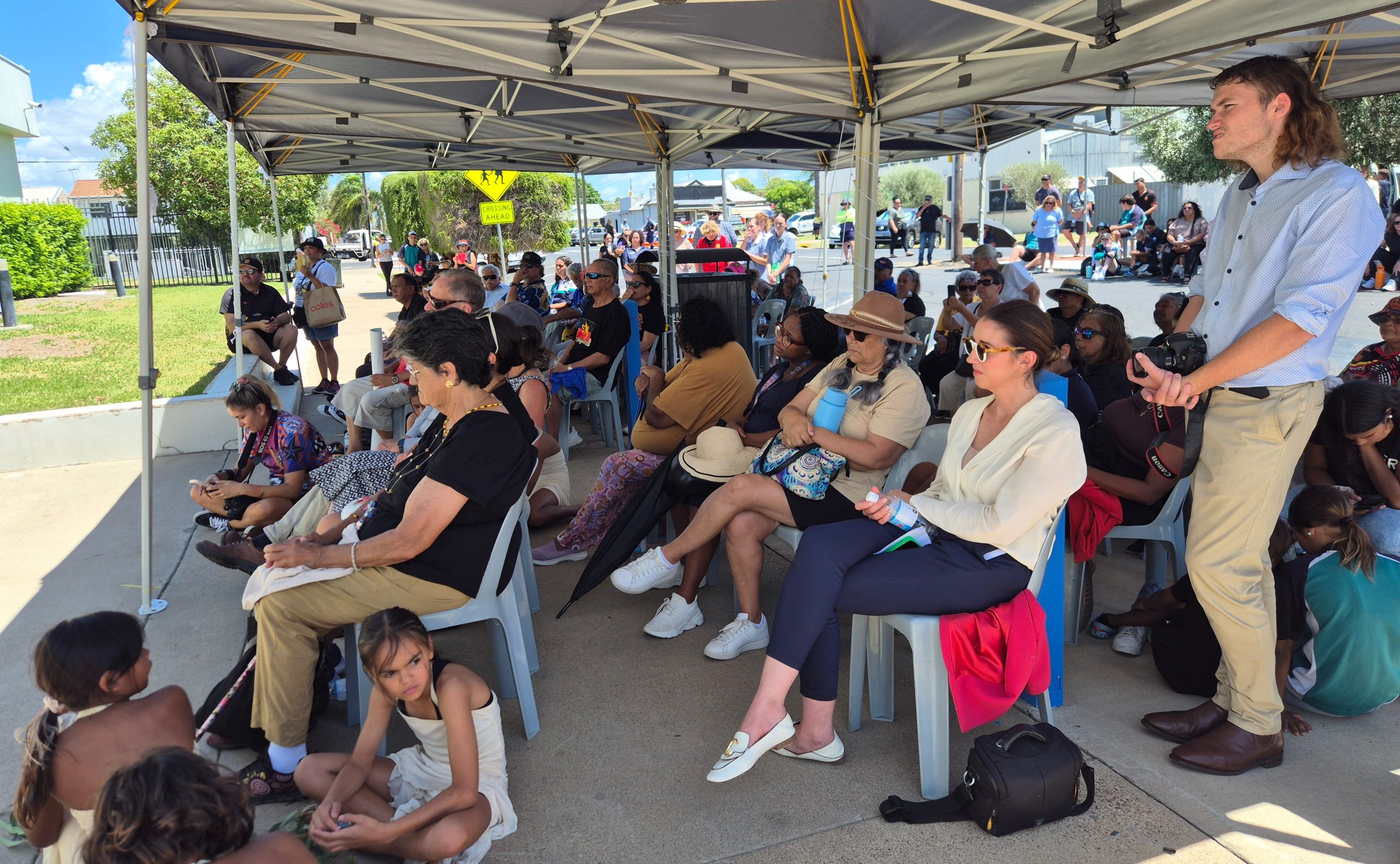
COMMUNITY members and elders stood as one on the steps of Moree War Memorial Town Hall on Wednesday to commemorate the 60th anniversary of the Freedom Ride that changed the mindset of an entire nation.
In the early hours of February 13, 1965, a busload of university students left Sydney with a common cause.
They wanted to expose the extreme hardship and segregation in towns and villages across outback New South Wales and southern Queensland.
On Wednesday this week, on the steps of Moree War Memorial Hall – one of the buildings Aboriginal people were not permitted to enter 60 years ago – a group of people paused and spoke about a chapter of Moree’s history that changed Australia forever.
The 60-year commemoration of the Freedom Ride was dedicated to Billy Craigie, one of the children who defied a Moree Municipal Council bylaw and took a swim at Moree Bore Baths one warm February afternoon in 1965.


































Special guests
Speaker Lloyd Munro addressed the large gathering and introduced guest speakers, including Phillip Hall from Walgett, Lyall Munro Junior from Moree, NSW Aboriginal Land Councillor Anne Dennis, Steve Widders from Armidale, Moree Plains Shire mayor Susannah Pearse and deputy mayor Wayne Tighe – the first indigenous person to hold the position.
Lyall Munro Junior dedicated the 60th anniversary ceremony to Billy Craigie, one of the co-founders in 1972 of the Aboriginal Tent Embassy at Parliament House in Canberra.
“Today is a pretty special day for some of us, and it’s a special day for the community,” Mr Munro said.
“The spirit of what we’re talking about is all about Billy Craigie, and that is why today is dedicated to him.
“Someone once said, Billy Craigie was the Malcolm X of Australia. Our heroes are as important to us as theirs are to them because the struggle for the rights of our people in this country is intertwined with the international struggle for the rights of first peoples,” Mr Munro said.





Walgett remembered
Phillip Hall told how Aboriginal returned servicemen were not allowed in the local RSL club on Anzac Day.
“They were refused entry after serving in both wars. They were given orange juice and sandwiches . . . but there weren’t good enough to go inside the club,” he said.
Mr Hall, who is travelling the route taken by the Freedom Riders in 1965, recalled incidents at Walgett swimming pool and the local cinema.
“I was one of the kids given a cake of soap and had to stand in a separate line with other Aboriginal kids to wash ourselves before we were allowed to go in the pool,” Mr Hall said.






“At the picture theatre, blacks weren’t allowed upstairs and had to sit down the front. My sister was given a ticket to go upstairs and was locked up for it.
“That’s the sort of thing we had to put up with,” he said.
Mr Hall praised the Freedom Riders, who set about changing the collective mindset of a nation 60 years ago.
“They put their lives on the line trying to get equal rights for Aboriginal people. It’s wonderful what they did. Charlie Perkins rode into Walgett on a bus with about 30 students and got a hero’s welcome,” Mr Hall said.
“The Freedom Ride was about trying to break a cycle and there were a lot of very good non-Aboriginal people that fought with us as well, and they suffered.
“A lot of their businesses went broke and they endured problems like being eliminated from certain town programs and groups, and I think the same thing happened here in Moree,” he said.
Billy Craigie’s legacy
Steven Widders, Billy Craigie’s first cousin, said the Freedom Ride was not just about Moree.
“This town was the catalyst, and what happened 60 years ago affected all of us . . . every one of us, right across Australia,” Mr Widders said.
“The Freedom Ride opened the true history of what was happening in country towns. It opened it up the people living in the cities that were not subject to racism . . . they didn’t see it.
“These brave students, black and white, and all the people who joined them on the Freedom Ride in February, 1965, made the rest of Australia open their eyes – and minds – to see the racism that was going on in all country towns throughout Australia,” he said.
The Freedom Ride also opened the way for activism and people like Billy Craigie and his sister Lyn, who joined up with people from all around the country.
“They were young people coming together as a result of what was highlighted throughout the Freedom Ride,” Mr Widders said.
“They said ‘let’s change the way for black people in this country’ – and they did.”
On Australia Day in 1972, Billy Craigie, Bert Williams, Michael Anderson and Tony Coorey went to Canberra and set up a tent on the lawns of Parliament House.
“That tent embassy has been continuous since that day. The fires have never gone out,” Mr Widders said.
“That was a vehicle for change in Aboriginal communities. Not just in Moree and Walgett and those towns the Freedom Riders went to, but the whole of the country, and I like to think things have changed because of the passion, motivation and activism of young people like Billy Craigie,” he said.
New South Wales Aboriginal Land Councillor, Anne Dennis, spoke powerfully about the life-changing events of six decades ago.
“The role of the Freedom Ride and all those students really opened the doors for our organisations to be established – from Aboriginal legal services to medical services,” Ms Dennis said.
“One thing we do know, is that our old people never gave up the fight . . . they never resisted.
“In every community, racism and discrimination was rife, and our old people wanted a better life. “They wanted better conditions for us, and every one of them stood their ground.
“What the Freedom Riders did, was expose that and they stood with the communities,” she said.
“People stood strong and families came together for support and expose what was going on, and it was pleasing to know that other people walked with us,” she said.
I love this town
Moree deputy mayor, Wayne Tighe, said a lot has changed in Moree over more than half a century.
“Moree has come a long way, and we’ve achieved a lot over the years,” Cr Tighe said.
“I’m a bit biased when it comes to living in Moree. I absolutely love the town.
“We are a prosperous town, a beautiful town, and the camaraderie we have in our community is hard to find anywhere else.
“There is support from the entire community – black or white, it doesn’t matter. Everybody supports one another when the chips are down,” he said.
Wednesday’s ceremony was followed by a march across Moree to the local swimming pool – now called Moree Artesian Aquatic Centre – where a large crowd relived the traumatic events that unfolded there 60 years ago this week.
1965 a pivotal year
Moree mayor, Susannah Pearse, said 1965 was a pivotal year in the rich history of Moree.
“The Freedom Riders shone a light on a lot of the things that had been happening in Moree, including the bylaws that were put in place by Moree Municipal Council in 1955,” Cr Pearse said.
“Those bylaws, essentially, formed the basis for a lot of segregation in the community. They prevented Aboriginal people from accessing some of our community facilities like the Moree Bore Baths and Memorial Hall.
“The standard set by the council at the time was then replicated across the community, meaning other businesses implemented restrictions, preventing Aboriginal people from accessing their premises,” she said.
“Today is about recognising that period in time, and recognising the huge impact that was made by the Freedom Riders.
“They stood up for what was right, called out what was wrong, and stood with the local Aboriginal people, and other people in the Moree community saying it was time to change,” she said.
“The effects of the Freedom Ride cannot be underestimated in terms of its impact on our community, but also the broader Australian community.
“The Freedom Ride has left a lasting legacy not only on our community, but also the nation.
“They shone a spotlight on segregation in Moree and the impact it had on our local Aboriginal people, and their plight, and that led to much bigger things,” Cr Pearse said.
Moree Plains Shire Council recently resolved to recognise the Freedom Ride every year.
“We believe it’s really important to do this,” Cr Pearse said.
“And not just pausing to remember the challenges the community experienced, but also pausing to consider what more there is still to be done.”
Words and Images: Bill Poulos
Historical images courtesy of Mitchell Library, State Library of New South Wales, and Courtesy SEARCH Foundation.



0 Comments