POLICE Constable William Badcock huddled against the fresh night air as he foot-patrolled the streets of Moree.
It was a cold winter’s evening on June 22, 1910 – a still night, but bitterly cold. A full moon made visibility quite easy.
Surely, pondered Badcock, it was too cold for people to be out at this hour.
At about 9.15pm, as he headed down Frome Street toward McIntosh’s Store, Badcock heard moans and a cry for help from the rear of the imposing premises.
The constable rushed to the back of the building. He found 56-year-old store manager John Kibby in a dazed state in the backyard, near the latrine.
Kibby’s face was covered in blood.
“What happened, Mr Kibby?” Badcock asked frantically.
“Billy tried to kill me,” Kibby half-choked.
“Billy who?” the constable asked.
“Billy Edwards.”
About half-an-hour earlier, Kibby had returned to the store to double-check everything was in order.
It was a routine, security stroll-through he performed daily, usually after his evening meal with his wife, Marian Jane.
The Kibbys moved to Moree from Leichhardt in Sydney the year before and were lodging at the Post Office Hotel, across the road from the store, founded in the 1880s by Alex McIntosh.
After making sure everything was in order, Kibby relieved himself in the outhouse at the rear of the premises.
He had one last look around the backyard and headed back to the hotel.
But rather than being only a minute or two away from a warm, cosy bed on this cold winter’s night, Kibby was violently throttled from behind with a blunt instrument, allegedly wielded by Billy Edwards.
A hammer, believed to be the weapon used in the attack, was later found beside the outhouse.
The handle was broken, with the detached piece nearby.
It was identified as belonging to Tattersalls Hotel, where Edwards boarded, however there was some conjecture afterward about its true ownership.
Kibby’s one saving grace was that his groans were heard by constable Badcock.
“Are you sure it was Billy?” Badcock asked.
“Yes; definitely. When I came out (of the latrine), Edwards said, ‘Good night, Mr Kibby’, and struck me several times on the head and face, knocking me down,” Kibby said.
“When I fell, he hit me again. I sang out, but he ran away.”
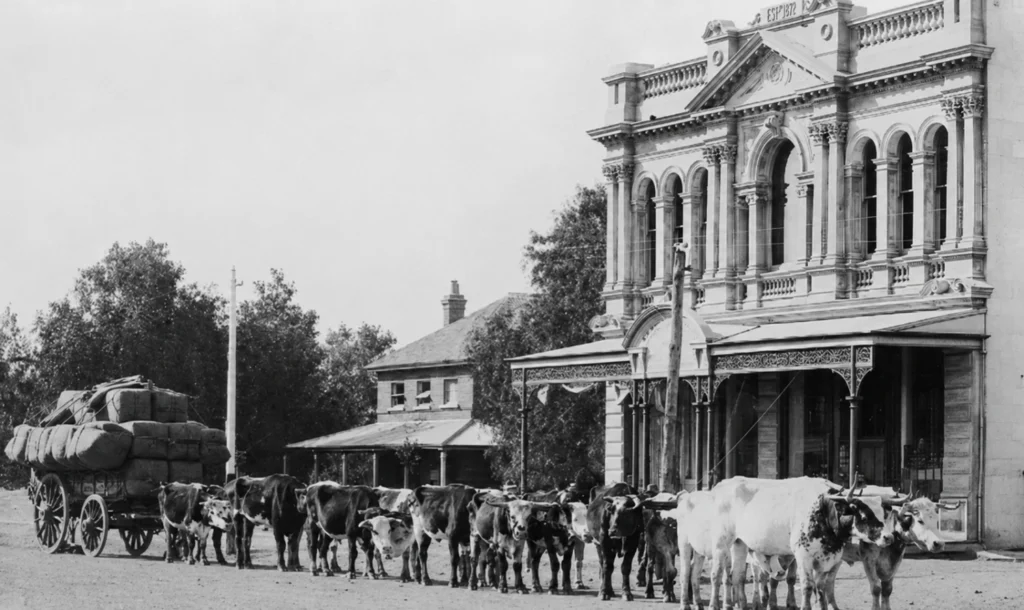
The imposing McIntosh’s Store on Frome Street, Moree. The store was located about where the Moree Police Station now stands (Image: Moree and District Historical Society).
It was easy for Kibby to identify 25-year-old William James Edwards.
Edwards was a well-known Moree resident, known by everyone as Billy, and was a green-grocer once employed at McIntosh’s Store.
He finished up about six weeks before the assault – Kibby was his former boss.
“What was he wearing?” constable Badcock asked.
“A dark overcoat and a soft felt hat,” Kibby said.
There was absolutely no doubt in Kibby’s mind, Billy Edwards was the assailant.
After making sure Kibby was comfortable, constable Badcock rose to leave and get help – and find Edwards.
A corner of the store’s backyard adjoined the backyard of Tattersall’s Hotel, where the suspect was boarding.
“Don’t leave me, constable, I’m dying,” Kibby pleaded.
Around the time constable Badcock was helping Kibby, postal assistant Bert Hughes also heard the distressed store manager’s cry for help.
He and two acquaintances, Alex Veitch and James King, rushed to the back of McIntosh’s Store, where they found constable Badcock nursing Kibby.
Hughes, who lodged at neighbouring Taylor’s Boarding House, later told police he saw Billy Edwards near McIntosh’s Store shortly after 8pm.
Taylor’s Boarding House and McIntosh’s Store shared a common backyard.
“The night was clear enough for me to recognise him,” Hughes said.
Hughes, Veitch and King helped Kibby to Dr Martin Magill’s Glendalough Private Hospital, a short distance away on the corner of Frome and Albert Streets.
As they slowly made their way to the hospital, Kibby described his ordeal.
“I came out of the toilet and got on my clothing when he struck me several times on the head. He then ran up and down the yard like a mad cat. I heard something rattle over the fence, as if he was climbing it,” Kibby said.
“Billy Edwards did it. I know his voice and saw him plainly.
“Please don’t tell Mrs Kibby, not right away; I don’t want her to worry,” he asked Hughes, as they limped across Frome Street.
Dr Magill treated and bandaged the store manager’s injuries.
“You have been knocked about, Mr Kibby,” Dr Magill said.
“Yes,” replied Kibby, “I know who did it.”
There was a scalp wound on the top of Kibby’s head which was bleeding freely; an injury to the left eye; and a deep wound on the left temple.
“Is my eye OK? Is it out?” Kibby asked anxiously.
“It is still attached Mr Kibby, but the wound is very serious,” Dr Magill replied.
The doctor also treated Kibby for minor wounds on the bridge of the nose and a cut across the left eye.
Once treated, Kibby was escorted to the Post Office Hotel to his wife, Marian Jane.
“Who did this to you,” she implored, holding her wounded husband.
Bandages on Kibby’s head and left eye were soaked with blood.
“Edwards said ‘good night, Mr Kibby’ and then struck me in the eye with something. Then he hit me again, and I fell and cried out ‘murder’,” Kibby told his wife.
Kibby told Marian Jane that during the attack he grappled with Edwards and at one stage held him briefly.
A search began for Billy Edwards.
At 7am the next morning Constable John Campbell spotted Edwards heading towards Tattersall’s Hotel and followed the suspect to his lodgings and watched him enter his room.
Campbell knocked loudly. Edwards opened the door slowly. He looked tired and haggard and in need of a good sleep.
“I want you to get up and come to the police station with me. The police have been looking for you,” Campbell said.
“Can I have a kip first – I’ve been out all night,” Edwards replied.
“Did you hear anything about Mr Kibby being assaulted last night?”
Edwards said he was aware of the assault, but knew nothing about it. He claimed he was out tomcatting.
“I heard about that, but it’s awkward for me to say where I was last night,” he said.
“You’re accused of assaulting him; you’d better come with me. Get dressed,” the constable said.
Campbell escorted Edwards to Moree Police Station and charged him with malicious wounding with intent to inflict grievous bodily harm on John Kibby.
“I know nothing about it,” Edwards pleaded.
Back at the station, about a block from where the assault took place, the accused gave a statement to Constable Badcock.
Edwards told Badcock he ate his evening meal at Tattersall’s Hotel at about 6pm.
“After that I sat in the parlour for a while, and then went to the post office. After waiting there for some time I came back to the hotel and went down to the back yard,” Edwards said.
He claimed he returned to his room at around 9.30pm.
“I left after that, but would rather not say where I was, if you know what I mean,” Edwards said.
Badcock asked Edwards if he was with anyone from the time he left the hotel – after his evening meal – until he came back to the hotel.
“No; I was talking to two boarders and to a girl on the hotel verandah for a few minutes before I left to go downstairs.”
Edwards intimated he was somewhere he should not have been the night of the assault, but refused to say where he was or the company he kept.
About half-an-hour after Edwards made the statement, Constable Badcock showed him the hammer.
“Have you ever seen this before,” Badcock asked.
“Yes, it belongs to Tattersall’s Hotel,” Edwards replied.
“It’s the hammer I have seen the girls at the pub using, but I can’t say how long since I saw it.”
William James Edwards was taken to Moree Police Court, where he was charged before magistrate John Jamieson with malicious wounding with intent to inflict grievous bodily harm to John Kibby.
Police Prosecutor Senior-Sergeant David Hill said Kibby was bedridden as a result of his injuries and asked for a remand.
The case was remanded for eight days and Edwards released on bail.
On July 6 the charge was upgraded to wounding with intent to murder.
Kibby remained bedridden at the Post Office Hotel and was treated daily by Dr Magill.
At no time did Kibby make a statement to police about the events that unfolded behind McIntosh’s Store on the evening of June 22.
One week after the attack, on Wednesday, June 29, Kibby returned to Glendalough Private Hospital for surgery to remove his left eye.
On Saturday, July 2, while still in hospital, Kibby suffered a paralytic stroke. Four days later he underwent surgery for the removal of a blood clot in the brain.
The next day he was dead.
The coronial inquest into the death of John Kibby began on Friday, July 8 at Moree Court House before Coroner John Jamieson.
The broken hammer, believed to belong to Tattersall’s Hotel, was presented as evidence.
Solicitor Alfredo Boleslas Fortunato Zlotkowski appeared for William James Edwards and the crown’s case was presented by Police Prosecutor Sub-Inspector Simon Butler and Senior-Sergeant David Hill.
Dr Magill told the inquest John Kibby was presented to his private hospital at around 9.30pm on Wednesday, June 22 with serious head and eye injuries.
“There was a scalp wound on the top of the head which was bleeding freely,” he told Coroner Jamieson.
“A blunt instrument could cause the wound on the top of the head. It could have been inflicted by the edge of the head of the hammer produced.
“The hammer would have to be held in a slanting direction to cause the wound – it would depend on the position of the victim,” Dr Magill said.
He said there did not appear to be any fractures to the skull but Kibby’s left eye serious. The eye was later removed.
“The deceased did not seem inclined to say how the injuries were caused, but said he knew who did it,” Dr Magill said.
Dr Magill said “dangerous and unfavourable symptoms” first appeared on July 2, four days after eye surgery, when Kibby was seized with paralysis, attributed to a probable clot on the brain.
Emergency surgery was performed by doctors Magill and Hinder, a Sydney specialist brought to Moree to perform the operation, where a portion of the skull was removed.
“Nothing unusual was found, and there were no blood clots,” Dr Magill said.
Kibby died the following day at 8.30pm.
The day after Kibby’s death Dr Magill performed a post-mortem on the body and found several small blood clots deep inside the brain.
“The vessels of the brain were congested, and two small patches of softening injuries (were found), sufficient to cause death,” Dr Magill said.
“The blood vessel in the vein became blocked up, causing small extravasation, which might have arisen either as the result of the injuries described, or the result of the unhealthy heart which was diseased, large and dilated.”
Dr Magill could not form a definite opinion as to whether the blood clots were caused by the condition of Kibby’s heart or from injuries received.
“Even if the blood clot was found before the operation it would not have been possible to save the deceased’s life,” Dr Magill told the inquest.
A hotel employee and two boarders Edwards chatted with gave evidence – and all said they spoke with Edwards between 9pm and 9.30pm, around the time Kibby was bashed.
Clerk Bill McCredie said he saw Edwards a little after 9pm at Tattersall’s Hotel and bid him goodnight.
“I did not see Edwards again that night,” he told the inquest.
Blacksmith Alf Isackson said Edwards spoke with him on the veranda of Tattersall’s Hotel for 10 or 15 minutes between 9pm and 9.30pm.
“Edwards said goodnight and went upstairs,” Isackson deposed.
Tattersall’s Hotel parlour maid Louisa Grunow said she observed Edwards go upstairs at about 9.30pm.
“He said goodnight to me as he passed and I did not see him again that night,” she said.
Albert Hughes, who helped escort Kibby to Dr Magill’s private hospital, said between 9.30pm and 9.40pm he was shaving in his bedroom at Taylor’s Boarding House when he heard “someone cry for help”.
Hughes also deposed he saw Edwards around 8pm near McIntosh’s Store “walking slowly”.
After hearing four days’ evidence Coroner Jamieson returned his verdict: death resulted from injuries inflicted by William James Edwards on the evening of Wednesday, June 22, 1910.
On Tuesday, July 19, Edwards was arrested at Moree Police Station by constables Badcock and Campbell.
Edwards was charged with the wilful murder of John Kibby and committed for trial, set down for Monday, October 11, 1910 at Tamworth Circuit Court before Chief Justice William Cullen.
Edwards was defended by Sydney barrister Albert Bathurst Piddington, as instructed by Moree solicitor Alfredo Zlotkowski.
Edwards pleaded not guilty to the charge.
Dr Magill deposed Kibby suffered serious injuries on the night of the assault.
“The left eye was swollen and black, and so was the right to a certain extent. He bled a good deal. The scalp wounds were not very serious. The wound to the eye was serious. It was completely disorganised. Had he lived he would not have the use of the eye,” Dr Magill said.
“I made a post-mortem examination and found clots of blood on the brain, and a contused artery. “He had a bad heart. Probably the heart was responsible for the clots. The hammer produced (as evidence) could have caused the wounds.
“The heart was dilated. A man in that condition might sustain a stroke of paralysis at any time. In my opinion the clot came from the heart accelerated by injuries,” he told Chief Justice Cullen.
However, the Crown’s case, led by police prosecutor Francis Russell, completely crumbled when defence counsel Albert Piddington argued Kibby’s plea to constable Badcock after being assaulted – “don’t leave me, I am dying” – was inadmissible evidence.
Piddington argued the evidence should not be admitted, as it could not be regarded as Kibby’s “dying declaration”.
“When Mr Kibby said, ‘I’m dying,’ he wanted the constable to remain with him,” Piddington said.
Crown prosecutor Russell argued that when Kibby said he was dying “he was earnest about it”.
“It was not an expression of great pain. The words were not used in any light sense,” he told Chief Justice Cullen.
The evidence was rejected by the Chief Justice.
“I cannot carry the case any further,” Russell despaired.
“I have other Crown evidence but it is impossible to identify the accused with the assailant.”
“Under those circumstances,” Chief Justice Cullen replied, “there seems to be no proof against the accused in connection with this charge.”
Defence counsel Albert Piddington asked Chief Justice Cullen to direct the jury to return a verdict of not guilty.
His Honour gave the direction to the jury.
Edwards was acquitted, and walked out of Tamworth Court House a free man – despite being allegedly identified by Kibby as the assailant.
Defence counsel presented three witnesses – McCredie, Isackson and Grunow. All three were prepared to testify Edwards was at Tattersall’s Hotel at around the same time Kibby was assaulted.
The fact the hammer used in the attack was proven to belong to Tattersall’s Hotel, where Edwards boarded, could be interpreted as circumstantial.
However, Louisa Grunow, employed at the hotel for more than two years, claimed she did not recognise the hammer.
The case left quite a few questions unanswered, chiefly: did a murderer walk free?
Moving to Moree in 1909 to manage McIntosh’s Store was a new beginning for John and Marian Kibby.
But 12 months later, John Kibby was dead after being viciously attacked at the back of the store he managed for Norm McIntosh, the son of store founder Alex McIntosh.
After the death of her husband, Marian returned to Sydney.
She passed away in 1915 – one day after her 67th birthday – and is buried at Rookwood Cemetery alongside her husband.
Postscript
The move to Moree from Leichhardt in Sydney in 1909 was something of a fresh start for John and Marian Kibby, after failed business ventures in rural and coastal New South Wales cost them dearly.
John Kibby was born in Devon, England in 1854 and came to Australia in the 1870s.
He settled in Grafton as a draper in partnership with John Drinkwater and later moved to Temora in the Riverina district, where his brother Eli was a storekeeper.
Kibby met young widow Marian Jane Avery at Grafton and they were married at Scots’ Church, Sydney, New South Wales on December 14, 1877.
Marian Jane’s first husband, George Avery, passed away in 1875 at Grafton, aged 31.
In June, 1882 Kibby opened his own store – Kibby’s Trade Palace – at Cootamundra, about 30 miles south-east of Temora.
It was a huge investment and opened to great pomp and ceremony.
On Saturday, July 15, 1882, the Cootamundra Herald reported: “The opening ceremony was carried with much éclat, and was patronised by over 500 people. At considerable cost the best of instrumentalists were brought from Sydney to provide the music for dancing and, in addition, the Cootamundra Band performed at intervals in the upper story of the building.
“Refreshments were provided on a lavish scale, and everything was done to ensure enjoyment to the visitors. The tables in the refreshment room were heavily laden with a tempting spread, where the multitude was hospitably entertained.”
The newspaper reported the chief attraction was the building itself.
“Kibby’s Trade Palace is a two-story building, the ground floor being the business compartments, the upper story being the private dwelling. It contains 120,000 square-feet in all, and, on the ground floor, 80,000 feet for business purposes.”
John and Marian Jane arrived in Cootamundra in the late 1870s and Kibby’s brother, Eli joined them from Temora in the early 1880s.
Eli resided at Muttama, a small village about 16 miles south of Cootamundra, where he was at one stage landlord of the Muttama Hotel.
Kibby’s Trade Palace cost £3000 before the doors officially opened on Monday, July 9, 1882.
After three years’ trade, on November 23, 1885 John Kibby’s dreams were shattered when he was declared insolvent with liabilities of £10,053 4s 3d and assets valued at just £260.
Kibby and his family relocated to Leichhardt in Sydney and early in 1886 Chief Commissioner of Insolvent Estates George Hibbert Deffell appointed a first meeting of Kibby’s creditors at the Registrar in Insolvency in Phillip Street, Sydney.
In 1890, Kibby re-established himself in a store on Argent Street, Broken Hill but again suffered financially.
Kibby, and former Broken Hill postmaster William Malcolm Weatherall, in 1896 opened a general merchant store at Lismore but by February, 1897, the entire stock, plant and equipment was offered for sale by auction.
In early 1897 Kibby and Weatherall advertised in the Cootamundra Herald, seeking premises to rent but the intention to return to Cootamundra appears to have come to nothing.
In 1909 John Kibby went Moree to manage McIntosh’s Store for Norm McIntosh.
He died 12 months later after being assaulted at the back of the Frome Street premises.
His killer was never brought to trial.
Words: Bill Poulos