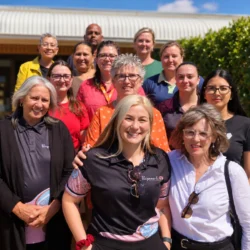
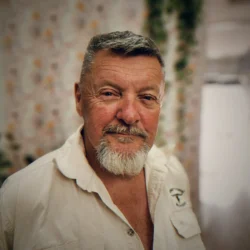
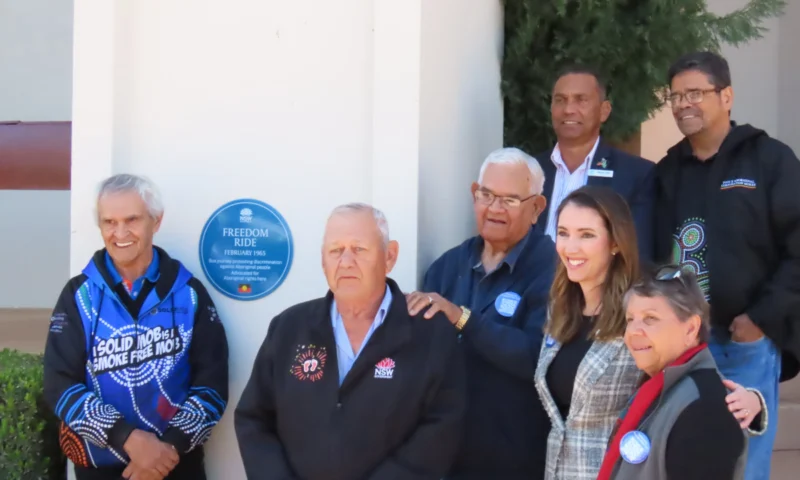
 Uncle Darryl French stood outside Moree Memorial Hall on Thursday, August 13, and pulled away the cover from a small blue plaque fixed to the wall.
It was a simple act, 61 years after the Freedom Ride came to Moree and challenged racial segregation in the town.
For Darryl and other Aboriginal Elders gathered for the unveiling, however, the history written on the plaque was not something learned from a book.
They had lived through it.
Some were children when Charles Perkins and a group of university students arrived in Moree in February 1965. They grew up on the mission, the common and camps on the edges of town at a time when Aboriginal people faced restrictions on where they could go and what they could do.
Yet when the Elders gathered inside the Memorial Hall after Thursday’s unveiling, their stories were not only about discrimination.
They spoke about childhood and family, dirt floors and mission life, education, resistance, the people who fought before the Freedom Riders arrived and the generations that came afterwards.
And they spoke about what should happen now that Moree’s part in that history is marked on the wall.
“Having that plaque out the side, it’s going to send a big message to this town,” Darryl said.
Children of the mission
Dianne Crighton was 11 years old when the Freedom Ride came to Moree.
Standing among other Elders 61 years later, she reflected on the lives of Aboriginal families who were forced to live on the fringes of the town.
“Today is a part of our history. Part of our legacy as well, all the old ones that went before us,” Dianne said.
“But we have to move forward.”
She remembered growing up on the mission as one of the best periods of her life, despite conditions that would now be understood very differently.
“Even though we were in segregation, we didn’t know that,” she said.
“It was just life.”
That tension ran through many of the stories shared during the lunch.
The Elders did not romanticise the discrimination Aboriginal people faced, but several remembered their childhood communities with affection.
Deborah Swan was eight years old when the Freedom Ride came through Moree and was living at Top Camp in a hut built by her father.
She remembered dirt floors, no electricity and water being brought in, but still described those years as some of the best of her life.
“We felt free, even though we weren’t allowed in town, but we felt free,” Deborah said.
She remembered children running around and playing together, but her reflections also turned to the lasting effects of what Aboriginal families experienced.
“The sad thing is some of our people are still living in trauma,” she said.
“And we’ve got to try and help and guide our people and our kids to get out of that trauma.”
A plaque people will stop and read
Lloyd Munro was five years old when the Freedom Ride came through Moree.
For him, Thursday’s unveiling created another moment in the town’s history.
“Today is history again with this plaque,” Lloyd said.
“People will walk past the Town Hall every day now and they’ll see that plaque and they’ll understand or they’ll want to know, you know, what happened in 1965.”
Lloyd also remembered mission life warmly.
“That was our best life really at the end of the day,” he said.
Like other speakers, he stressed the importance of passing knowledge from Elders to younger Aboriginal people.
“We still got a long way to go when it comes to respect and respecting our Elders especially,” he said.
“I believe there’s still a lot of knowledge in a lot of our old people that our young people need to connect to.”
For Lloyd, education remained central.
He recalled attending school on the mission before moving to Moree High School, where sitting in classrooms with white students was a new experience.
“Education is the key for our kids today,” he said.
But Lloyd also cautioned against telling the Freedom Ride story as though the struggle for Aboriginal rights in Moree began when Charles Perkins arrived.
“I believe before Charlie come, there also was a lot of fighting,” he said.
“A lot of Elders done a lot of the groundwork before Charlie come.”
The Freedom Ride, he said, strengthened a movement already underway among Aboriginal people in Moree.
What happened in Moree
The Freedom Riders arrived in Moree on February 15, 1965.
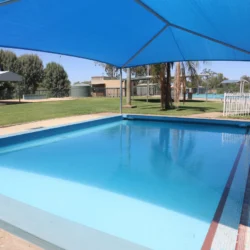
NSW Government Environment and Heritage records that they learned of a council by-law refusing Aboriginal people entry to the town pool.
The students carried out surveys, organised peaceful pickets and spoke with local residents before attending a public meeting at the Moree Memorial Town Hall that evening.
Local Aboriginal resident Neville Kelly called for the by-law to be abolished and, with support from businessman and former alderman Bob Brown, the motion passed.
The Freedom Riders left Moree but returned days later after learning the by-law had been reinstated.
They collected Aboriginal children from the Mission and Bingara Road Reserve and took them to the pool to demand equal access.
A hostile crowd gathered and several Freedom Riders were physically attacked.
After lengthy negotiations, the mayor agreed to remove the by-law.
Thursday’s Blue Plaque now marks Moree’s place on a heritage trail following the route of the 1965 Freedom Ride.
‘Your stories and your truths’
Moree Plains Shire Mayor Cr Susannah Pearse acknowledged at the unveiling that she could not speak from the experience of those who lived through that period.
“As a 43-year-old white woman who was not alive in 1965 when the Freedom Rides came through this community, I’m not going to stand here and tell you what happened or what it was like to be an Aboriginal person living in our community back then,” Cr Pearse said.
“Many of you here today lived and breathed that, and it’s your stories and your truths that need to be shared.”
Cr Pearse said council had formally confronted part of its own history.
In 2024, following a motion from Cr Pearse and former councillor Michaela Cochrane, council resolved to acknowledge the creation, enforcement and impact of the 1955 by-laws in reinforcing racial segregation.
Cr Pearse said she hoped the plaque would give residents and visitors a reason to stop and consider that history, its effect on Moree and what could be done to prevent past mistakes being repeated.
She then called Darryl forward to perform the official unveiling.
NSW’s first Blue Plaque trail
Heritage NSW Blue Plaques team member Maruschka Loupis travelled from Sydney for Thursday’s ceremony.
She said the Freedom Ride project was the first Blue Plaques trail created in NSW.
Heritage NSW spent about a year consulting communities along the original route, speaking with groups and individuals and looking for the locations that best told the story.
In Moree, the Memorial Hall emerged as the appropriate site.
“This was the best spot, the former town hall where decisions were made, famous photographs of the riders on the steps, so it kind of made sense,” Ms Loupis said.
The trail includes eight locations along the Freedom Ride route.
Six new plaques have been installed, joining an existing plaque at Walgett and another at Sydney’s Wayside Chapel.
Ms Loupis said one of the surprises during consultation was discovering that knowledge of the Freedom Ride was not universal, including in some Aboriginal communities along the route.
“We just assumed everyone knew and everyone cared,” she said.
“When people find out, they care, but the knowledge was not there.”
The aim, she said, was to preserve and share the stories communities had given Heritage NSW.
‘We were the game changers’
For Darryl, the plaque is about more than remembering what happened at the Moree pool.
Speaking after the unveiling, he paid tribute to Aboriginal people who pushed for change and to the non-Aboriginal university students who travelled alongside Charles Perkins.
He said their willingness to stand with Aboriginal people in that period should also be remembered.
But his focus repeatedly returned to what the story means for the generations growing up in Moree today.
Darryl spoke about young people asking him what it was like to live on the mission and what the Freedom Ride was about.
He said those conversations were an opportunity for truth-telling while also recognising the strength of the families who raised children through that period.
He reflected on achievements that would once have seemed beyond reach, including his own path to university and teaching Aboriginal students.
“Our generation, we’ve been the game changers,” Darryl said.
“And we kept on doing it and stood up for ourselves.”
For 61 years, the events of February 1965 have been carried in photographs, historical records and, most importantly, in the memories and stories of the people who lived through them.
Now part of that story sits on the wall of Moree Memorial Hall.
And as Darryl sees it, its job is not simply to tell people what happened.
It is to make the next generation ask.