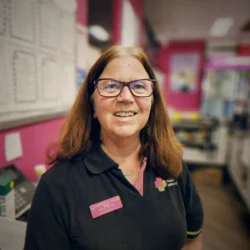
Moree AES office manager Carol French at the organisation’s Balo Street office. Photo: Moree Online News.
Two driving simulators sit in the middle of the Aboriginal Employment Strategy’s new Moree office.
They look a little like gaming rigs, but for the young people who use them, they have a practical purpose: learning road rules, recognising signs, understanding speed limits and becoming more comfortable with the idea of getting behind the wheel.
Nearby are computers for resumes and job applications. At the front is a board advertising available jobs. There is a private space for people who need help with paperwork, and another area used by community organisations and school groups.
It is a long way from the simple idea of an employment agency matching a person with a vacancy.
When AES moved operations to 66 Balo Street on Monday, August 3, the 100 per cent Indigenous-owned and operated charity brought about 30 years of employment work in Moree into a new space designed around the barriers people face before they can get a job.
Moree office manager Carol French said much of that work begins before a person is ready to apply for employment.
That can involve anything from identification and licences to training, resumes and confidence-building, depending on what is standing between the person and a job.
The current funded target group is Aboriginal people aged 15 to 30, but the door does not necessarily close when someone falls outside that age range.
Only recently, a man in his 60s came into the office asking for help with his resume.
“We won’t knock them back,” Ms French said.
More than a job application
For young people working towards a licence, AES provides access to driving simulators and a driver mentor who can help them build supervised driving hours.
The simulators use a driving program incorporating Australian road rules, road signs and speed limits, allowing users to work through a series of modules and become familiar with the rules before moving into real-world driving experience.
AES also supports eligible young people with costs involved in progressing through the licensing system.
Computers are available for people preparing resumes, searching for jobs, completing applications or working through other employment-related tasks.
Staff also regularly help people obtain documents and checks needed to enter the workforce. That can include birth certificates, tax file numbers, police checks and qualifications such as white cards, with AES working alongside other organisations and training providers where necessary.
Those steps can seem administrative, but without them a job opportunity can disappear before an application is even lodged.
The office also participates in Work and Development Orders, which can allow eligible people with fines to reduce their debt through approved activities.
Starting earlier
The Balo Street office is also used for programs with schools and young people, including sessions focused on employment preparation, career planning, resumes, job applications, training opportunities and confidence building.
An eight-week program previously run with Moree Secondary College encouraged students to think about what they wanted from the future before moving into practical questions about jobs, qualifications and training.
One of the first activities was creating a vision board and asking the students to think about how they saw their future. Later sessions moved into career plans, resumes, job applications and the qualifications they would need for the work that interested them.
“Each step, we’ll be there to support you,” Ms French said.
Staff work backwards from the job, helping people address the barriers that may stand between them and employment. That can mean helping someone obtain identification, work towards a driver’s licence, connect with training or prepare a resume.
A call to local employers
The relationship can work from the other direction as well, with Ms French encouraging Moree employers looking for workers to approach AES.
“Just get in contact. Say you’ve got this position vacant,” she said.
AES can then look at people registered with the service and identify jobseekers who may have suitable experience, qualifications or tickets.
There is no client cost simply for asking AES to help identify a suitable worker through that process, although separate fees may apply to some traineeship or labour-hire arrangements.
Ms French would like to see stronger links with local employers, particularly where businesses have positions they are struggling to fill.
Beyond its employment and youth programs, AES works with local training providers including Moree Community College and TAFE. Its meeting space is also available to community organisations and has been used by groups including the Aboriginal Legal Service, Aboriginal Interagency Group and Aboriginal Education Consultative Group.
Taken together, the services show that finding someone a job is only one part of the employment equation.
The job may be the end point, but much of AES’s work is about helping people reach the point where employment becomes possible.