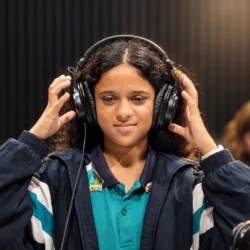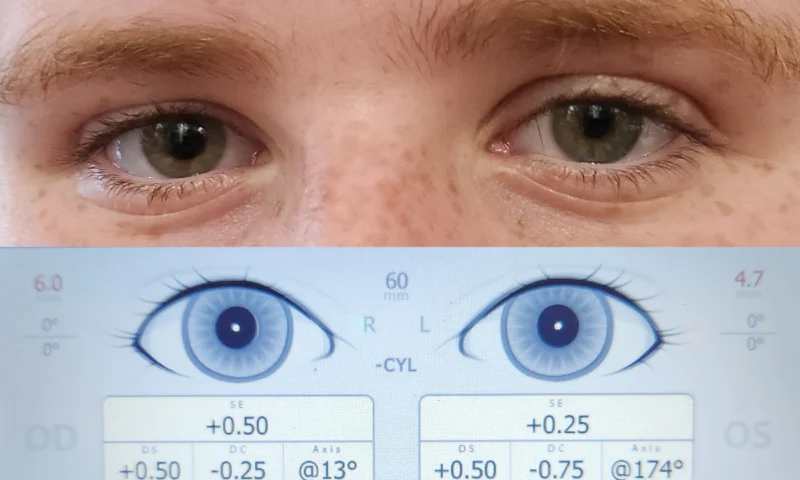
Moree Online News publisher Michael Phipps’ daughter has had anisocoria, or unequal pupil size, since birth. During a demonstration of the Lions children’s vision screening process, the screening camera flagged the condition and recommended a complete eye examination. Image: Moree Online News
A child who has always seen the world a certain way may have no reason to think there is anything wrong with their vision.
They may compensate by moving closer to what they are trying to see or simply assume everyone else sees the same way. It is this kind of problem Moree Lions hopes to find as it works to take free children’s vision screening into schools across Moree Plains.
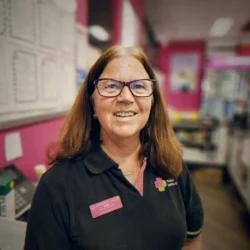
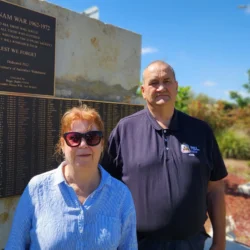
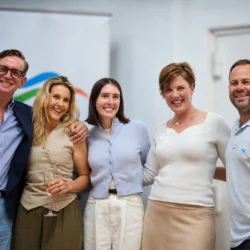
Moree Lions now has trained screeners qualified to conduct the program for children aged three to 18. Beth Hearn, Steve Long, Colin Paton and Candice Paton spoke with Moree Online News about plans to take it into local schools.
The Lions Eye Health Program (LEHP) says one in five children has an undetected vision condition.
More than an eye chart
The Lions screening checks several parts of a child’s vision. It includes visual acuity, colour perception and depth perception, as well as a specialised screening camera.
The camera can flag results linked with short-sightedness, long-sightedness, astigmatism, differences between the two eyes, eye misalignment and unequal pupil size.
The screening does not diagnose a condition. If a result falls outside the program’s set limits, the child’s family can be advised to arrange a full examination with an eye-health professional.
Locally, the screening generally takes five to 10 minutes, with older children sometimes finishing in less than five. That makes it easier for schools to send children through in small groups without taking a whole class away from lessons.
In one of their first local screening sessions, about 46 children went through the program and six were recommended for further attention, according to the screeners.
The numbers are only an early snapshot from a small local screening and cannot be used to estimate how common vision problems are among children across Moree Plains.
Nationally, LEHP says 19,240 children were screened through the program during 2025, with just over 20 per cent referred to an optometrist for further testing.
Why it matters in the classroom
The screeners have seen how a child having trouble seeing classroom material may move closer to compensate. In other cases, a child who cannot clearly follow what is on a board or screen may appear to lose interest.
Poor vision does not explain a child’s behaviour or school performance on its own, but research has found links between some vision problems and educational outcomes.
An Australian review found that reduced visual acuity and refractive error were linked with academic performance in a number of studies, although the researchers warned that the evidence was not strong enough to draw simple conclusions. More recent research has found a similar association between uncorrected vision problems and poorer educational outcomes, while cautioning that the evidence varies between studies.
At its most practical level, the issue is simple: children need to be able to clearly see the books, boards, screens and other material they are expected to learn from.
Seeing the screening first-hand
To better understand what children would experience during a Lions vision screening, Moree Online News publisher Michael Phipps had his daughter go through the process while reporting on the program.
She moved through the same screening activities other children would encounter, including checks of visual acuity, colour perception and depth perception before sitting in front of the screening camera.
Michael had almost forgotten that his daughter has had anisocoria, or unequal pupil size, since birth. But when the camera completed its screening, there it was on the screen: anisocoria, along with a recommendation for a complete eye examination.
It was not a new diagnosis. Her unequal pupil size was already known to the family. But seeing it flagged by the screening helped demonstrate first-hand what the process is designed to do.
For a family that does not already know there is a problem, a result like that could be the first reason to arrange a full eye examination.
Taking it into schools
Moree Lions has begun the practical work of getting the program into local schools.
Discussions have been held with several principals. Moree Secondary College and the local Christian school were receptive to the proposal when the screeners met with them, although screening dates had not been finalised at the time of the interview. Approaches to other schools were continuing.
Moree Lions hopes to eventually reach schools across Moree Plains, including smaller communities where visits will need to be planned around school calendars, travel and volunteer availability.
A screening session needs about six or seven volunteers to keep children moving through the different activities, and those volunteers do not have to be Lions members.
LEHP allows community volunteers to qualify as screeners after completing the required training, which includes online learning, a practical workshop and supervised screening experience. Screeners must also hold a current Working With Children Check or equivalent.
For Moree Lions, that means the program can grow beyond its current team if more local people choose to become involved.
LEHP began its Children’s Vision Screening Program in 2018. It set a national target of 17,000 children for 2026 and announced in July that the target had already been exceeded.
In Moree Plains, the local rollout is only beginning. The screeners are trained, talks with schools are under way and the next step is turning those discussions into screening days.
The children they eventually see may not arrive saying they have trouble with their eyesight.
For a child who has never seen the world any other way, poor vision can feel completely normal.