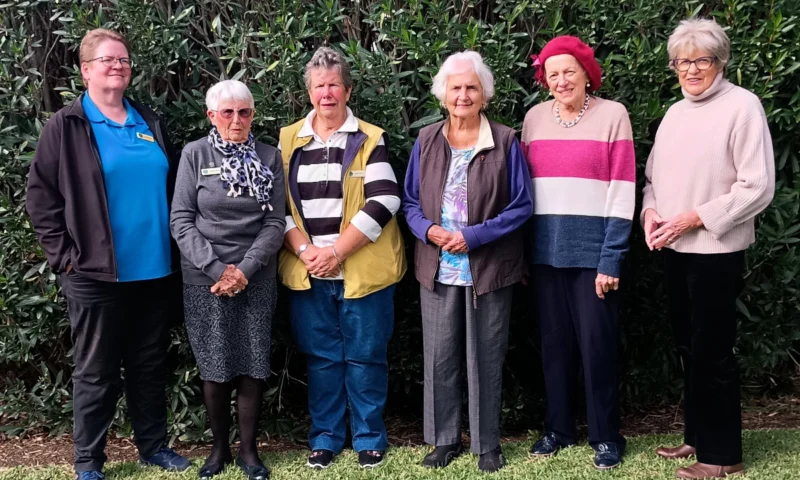
Remaining Moree CWA committee members, from left: Liz Egan, Robwyn Kennedy, Rose Taylor, Terri McFadeen, Merri Gill and Barbara Baz. Image supplied
The Moree branch of the Country Women’s Association officially closed on June 26, ending a 104-year history of women-led service, advocacy and friendship in the town.
But its story will not be packed away.
Former members have directed the branch’s remaining funds back into the local community, while the Moree & District Historical Society prepares a museum display about the CWA’s long connection with the town. The Moree Men’s Shed has also been helping prepare a display case for the branch banner.
The closure marks the end of formal meetings, catering rosters, fundraising tables and office-bearer duties, but not the end of the branch’s place in Moree’s history.
For more than a century, the Moree CWA gave country women a way to organise around practical needs: health care, travel, accommodation, education, family support, fundraising and the simple but important need for connection.
Final donations to Moree
Before closing, the branch distributed its remaining funds across local health, education and children’s services.
The final donations included:
- $4408 to Moree Hospital for the purchase of a Connex Spot Monitor.
- $2000 for Gwydir Mobile Children’s Service.
- $2000 for the Dr William Hunter Scholarship.
- $1900 for local education scholarships benefiting three students attending Moree schools in Years 7 to 10.
Committee member Liz Egan confirmed the Moree branch had contributed annually to the Dr William Hunter Scholarship and local school education scholarships before the closure.
The final committee keeping the branch running until its final days consisted of Liz Egan, Robwyn Kennedy, Rose Taylor, Terri McFadeen, Merri Gill and Barbara Baz.
The closure brings an end to a 104-year branch history that began in 1922, the same year the Country Women’s Association of NSW was established.
Built around practical need
The early work of the CWA in Moree was shaped by the realities of country life.
Roads were poor, travel was slow, communication was limited, and women on properties could be isolated by distance, weather and family responsibilities. A trip into Moree could take many hours, and for some families from outlying areas, access to health care and services required careful planning.
In that setting, the CWA was not simply a meeting group. It was a practical network.
Local history notes show the Moree branch pushed for baby health clinics and for dedicated spaces where expectant country mothers could come before childbirth or rest after long journeys into town.
Merri Gill said the branch’s baby health work reached back to the beginning of its history.
“Going right back 100 years, we were the first to start a baby health clinic here,” Mrs Gill said.
The first Baby Health Clinic began operating from the Moree Scout Hall in Gwydir Street. In 1927 / 1928, a dedicated clinic building was constructed on the corner of Kirkby Park.
That building later had its own history of survival and loss. It was raised after the 1955 flood and was later destroyed by fire.
The baby health work remains one of the clearest examples of how the branch turned women’s local knowledge into practical service. Members understood the distances families were travelling, the strain on mothers and babies, and the need for care that was closer to the people who needed it.
A place to stay, and a reason to come to town
The branch was also tied to accommodation support for girls and women from outlying areas.
The CWA Hostel helped families manage the distances involved in schooling, health care and other services. For country girls, staying in town could make secondary schooling more possible. For women travelling into Moree for medical reasons, accommodation could mean not having to make a long, difficult journey at the last possible moment.
Robwyn Kennedy said the hostel reflected how different country life was when the branch began.
“Times have changed,” Mrs Kennedy said.
“When we began in 1922, having a baby, a lot of people came to the hostels to wait instead of being stuck out and then having to rush to town.”
It shows how the CWA’s work was often about solving problems that were ordinary to country families but invisible to people who lived close to services.
The branch’s role was not always glamorous. It was often practical, local and repetitive: raise the money, organise the rooms, cook the food, hold the meeting, write the motion, lobby the right person, help the next family.
More than scones and jam
Former members said the public image of the CWA often settled on scones, jam and catering, but the organisation’s work went well beyond that.
Liz Egan said that image did not reflect the full work of the organisation.
“We do have, unfortunately, that scones and jam image,” Ms Egan said.
“But we’re probably so much more than that.”
Catering mattered because it raised money. Show work, street stalls and event catering helped turn volunteer time into scholarships, donations and support for local services.
Members recalled catering for events at the Moree Show and other local functions, with local organisations often turning to the CWA when they wanted community catering rather than a larger outside provider.
But members said the quieter work behind the scenes was just as important.
Through the CWA, local concerns could be discussed, shaped into motions, debated at conference and carried through the organisation’s advocacy channels.
Ms Egan said the organisation had worked on issues affecting women, children and country communities, including road safety, drought support, regional health services, affordable housing for older women, palliative care in regional areas and support for refugee women.
Those issues were advocated for and lobbied for “in the background” through the organisation’s state executive, she said.
That advocacy role gave women in regional towns a formal way to be heard on issues that affected their families and communities.
Friendship and town days
The CWA was also social in the deepest country sense of the word.
For women living out of town, a monthly meeting could anchor the whole day. Members would plan a trip into Moree around the meeting, fitting in grocery shopping, appointments, banking and other town business before sitting down with other women for lunch, conversation and branch work.
“It was friendship,” Mrs Kennedy said.
“I lived 40 miles from town and I used to go in once a month to a meeting. We did the shopping that day and any other business we needed to attend to.
“We had our meeting and our lunch, and we enjoyed it. It was camaraderie and discussing interesting topics.”
Those days created friendships as well as fundraising.
Members spoke about shared lunches, discussions, learning about other countries, cooking, needlework and the pleasure of being in a room with women who understood country life.
That social connection mattered. For women who lived many kilometres from town, the branch offered company, routine and a reason to leave the property for something that was both useful and enjoyable.
Changing with the times
The Moree branch did not remain fixed in the past.
In recent decades, members continued to raise current community issues, including mental health, domestic violence and coercive control.
Joy Holmes, who joined the branch in 2013 and served as president from 2015 to 2021, was credited by fellow members with helping the organisation take on important community advocacy programs.
“We have to give credit to our president Joy Holmes for bringing these issues up,” Mrs Gill said.
During her time with the branch, Moree CWA hosted a rape and domestic violence workshop in April 2016 for people working in the field and people at risk in the community.
The branch also supported a public forum on domestic violence and coercive control in July 2024.
On April 4, 2025, Mrs Holmes helped coordinate a free community screening of the independent film Just A Farmer at the Town and Country Club. More than 100 people attended the screening, which was designed to encourage conversation about mental health and suicide awareness in rural communities.
Mrs Kennedy said Just A Farmer helped open discussion about “changing things on the rural landscape” and the pressure of drought and worry on families.
Those events showed the branch was still willing to use its name, network and organisational experience to bring difficult subjects into public conversation.
Why the branch closed
Members said the decision to close the branch was not sudden, and it was not caused by one single setback.
It reflected broader social shifts affecting volunteer organisations across regional Australia.
“There are two issues,” Mrs Gill said.
“It’s changes in society, and we’re getting older.”
Ms Egan said it was difficult for younger people to get involved, particularly while working full-time or raising young families.
“If you’ve got young families, you’ve got other commitments that are taking people’s time these days,” she said.
COVID also disrupted fundraising and regular activities. At the same time, the practical workload of catering, running a branch and carrying committee responsibilities became harder for an ageing membership base.
“It’s just harder to attract new members, particularly younger members, and the age group is getting quite advanced,” Ms Egan said.
By June 2026, active membership had dwindled to about six women. Ms Egan said when she joined in 2014, the branch had closer to 15 or 16 active participants.
Members also noted that Moree’s younger volunteers are not necessarily absent from community life. Many are active in other groups, causes and networks. The challenge was attracting them to a traditional branch structure that required regular meetings, office-bearers and ongoing administrative work.
Mrs Gill said younger people appeared to be involved in other groups and causes.
“Perhaps they are interested in other groups,” she said.
“It’s very hard to get interest.”
The difficulty was not unique to Moree CWA.
“People don’t want to take on office-bearing roles,” Ms Egan said.
“They’re quite happy to support it, but we need lots of people like that.”
Preserving the legacy
Although the branch has closed, the physical history of the Moree CWA will be looked after by the Moree & District Historical Society.
A display is being prepared for the James Pritchard Memorial Room and is expected to open in August.
It will feature historical photographs, a written history of Moree CWA and the early Baby Health Clinics, CWA books and the branch’s centenary banner, made by Sylvia Macey.
The Historical Society has said the display can continue to evolve as new material becomes available. The museum is welcoming loans or donations of Moree CWA photographs, documents, memorabilia or personal stories from community members.
That evolving display means the closure of the branch does not have to be the end of the public story.
The formal meetings may have come to an end, but the name, the banner, the records and the branch’s 104-year record of community service will remain part of Moree’s public history.
Exhibition information
- Where: James Pritchard Memorial Room, Moree & District Historical Society.
- When: Expected to open in August.
- Get involved: To donate or loan historical CWA material, contact the museum at [email protected] or visit the museum in person.