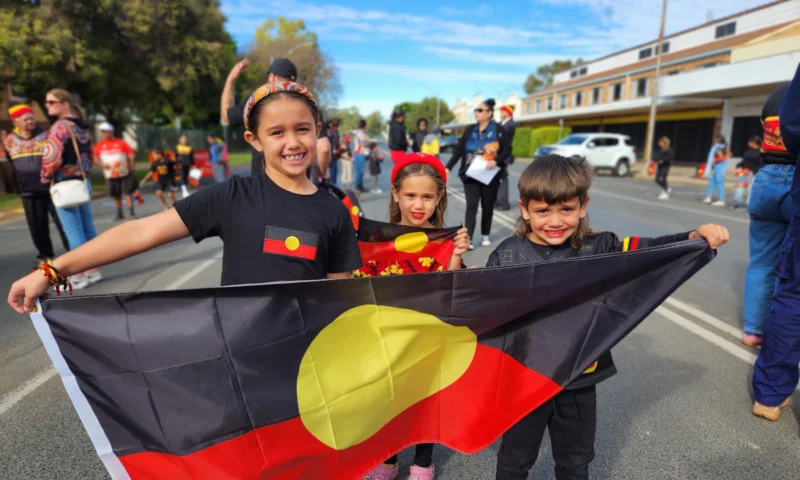
Children carry the Aboriginal flag during the NAIDOC Week march to Moree Memorial Hall. Image: Moree Online News
Moree’s official NAIDOC Week celebrations began at Dhiiyaan Aboriginal Centre on Monday morning before community members marched to Moree Memorial Hall for the week’s formal opening ceremony.
The morning started with a gathering and morning tea at the centre, where a NAIDOC Week display of photographs from across the shire’s history was also on show. From there, participants marched to the front steps of Moree Memorial Hall for a Welcome to Country, speeches from Elders, councillors and students, and a flag-raising ceremony.
The official opening marked 50 Years of Deadly and brought together themes of celebration, protest, local history and the next generation.
Elder Uncle Lyall Munro Jnr used his address to place Moree’s NAIDOC Week in a longer history of Aboriginal protest, survival and local leadership.
He traced NAIDOC’s history back to the 1938 Day of Mourning and the Aboriginal rights movement, and said Moree had played an important role in that story.
Uncle Lyall told the gathering Moree hosted one of the early NAIDOC events outside Sydney in 1970, after what he described as the first event in Sydney in 1969.
“There’s a historical lesson here,” he said.
He said Moree had produced people who had contributed to national Aboriginal rights campaigns, and urged the town to better recognise its own Aboriginal history and local leaders.
In remarks about the impact of past restrictions on Aboriginal people in Moree, Uncle Lyall characterised local government decisions made before the 1967 referendum as legislated racism.
“This town is the only town that legislated racism,” he said.
While his address looked back to history, Uncle Lyall said the community also needed to focus on young people and the future.
“We can’t stand up here and talk about the future and the role of our children in the future if we can’t provide a role for our children in the contemporary sense,” he said.
“It takes the community to raise a child. Not only his parents and family, it takes our community.”
Mayor Susannah Pearse said Uncle Lyall’s words were important to hear, and said NAIDOC Week carried more than one meaning.
“NAIDOC Week has been about two things. It’s been about protest as well as being about celebration,” she said.
“For people like me, non-Aboriginal people, sometimes some of the discussions can be uncomfortable, and we have to sit in that uncomfortableness. We have to pause, and we have to think, and we have to consider what we all can be doing to not just recognise the past, but also make sure the future is brighter for our Aboriginal community in this town.”
The Mayor acknowledged Moree Plains Shire Council’s two Aboriginal councillors, Deputy Mayor Wayne Tighe and Cr Fred McGrady, and thanked the NAIDOC Week committee and participating organisations for the week’s program.
She also encouraged residents to visit Dhiiyaan Aboriginal Centre to see the photograph display.
Cr McGrady said the 2026 theme, 50 Years of Deadly, was an opportunity to recognise Aboriginal and Torres Strait Islander culture, resilience, strength and achievement.
“It is important for all Australians to reflect on our shared history, celebrate the world’s oldest continuing cultures and recognise the contribution First Nations people make to our communities every day,” he said.
“As a proud Aboriginal person, I am honoured to celebrate NAIDOC Week alongside my fellow councillors, including Deputy Mayor Tighe, and with all of you.”
Cr Tighe said NAIDOC had changed significantly over the years and was now more inclusive of the wider community.
“Once before, you came and raised the flag. But now it’s broader across the community, to involve the whole community,” he said.
He said NAIDOC was a time to bring people together and honour the work Aboriginal and Torres Strait Islander people had done across generations.
Cr Tighe also said he was proud council had Aboriginal employment above 21 per cent, and said he would like to see that grow further.
Local students Lorna Haines and Demi Green were among the young speakers who reflected on culture, identity and the future.
“As young people, we are a part of that story too,” the students said during their reflection.
“We are the next generation. We are the future leaders, teachers, artists, athletes, carers and changemakers.
“The strength of our Elders gives us courage, the vision of our communities gives us direction, and the legacy of our ancestors gives us pride.”
Lorna later said being Aboriginal meant being part of “a very loving community”.
Demi said being Aboriginal was a source of pride and motivation.
“It’s part of who I am,” Demi said.
“It gives me a lot of motivation to do everything I do. I always think of my ancestors, my old people, and everything they’ve done and everything they’ve been through.”
The official opening followed Moree Online News’ earlier coverage of the full NAIDOC Week program, which continues across the Moree Plains this week.